WIth consumers increasingly skeptical of advertising, what’s the real difference between a brand that’s being genuinely helpful and one that’s just being creepy?
Agility requires brands to not just react to consumer behavior, but to anticipate it with smarter technology. It’s about shifting from broad assumptions to a nuanced understanding of intent, especially when economic uncertainty changes the rules of engagement.
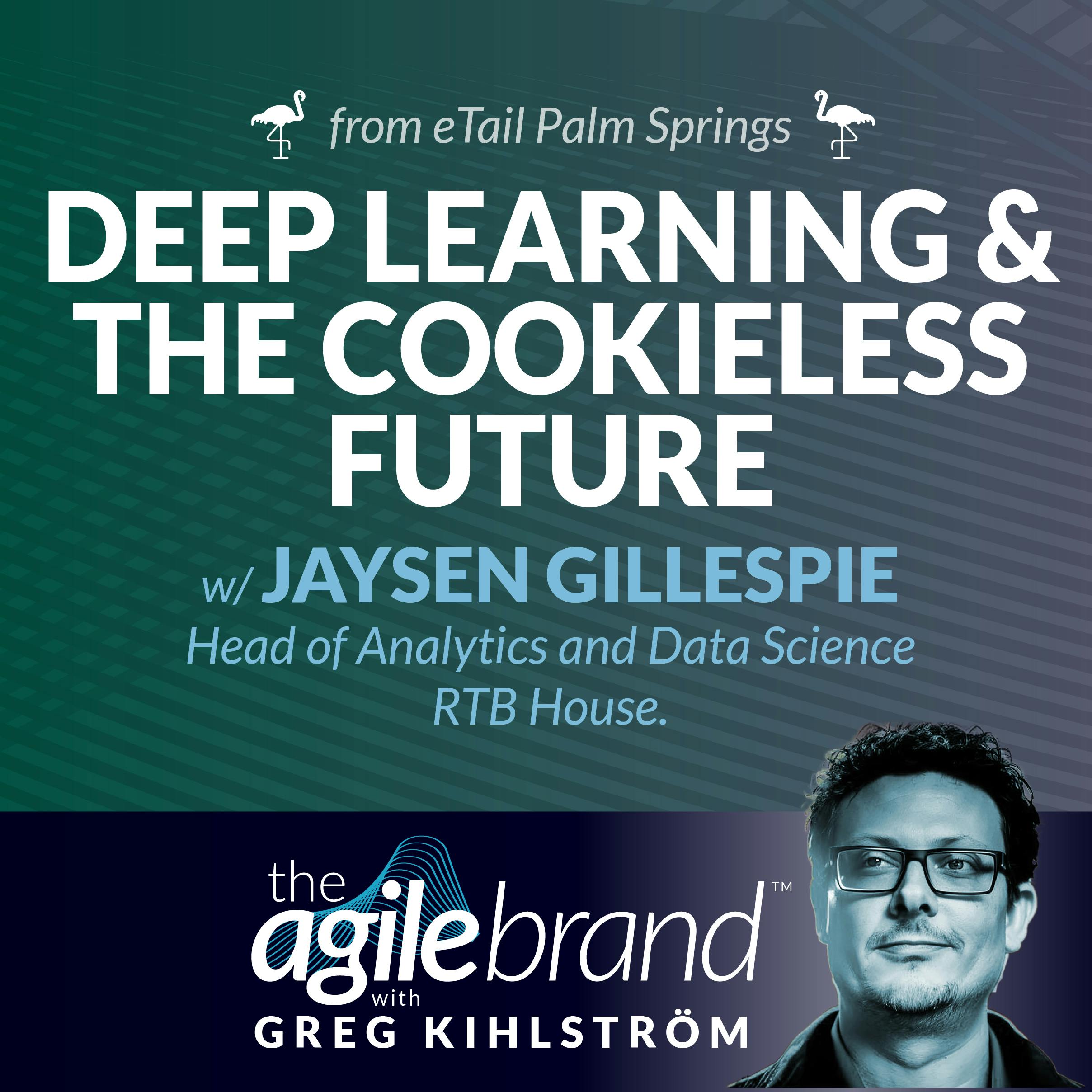
Today we are here at eTail Palm Springs, and we’re going to talk about the evolution of performance marketing in an era of signal loss and consumer uncertainty. As traditional methods like third-party cookies fade away, marketers need new tools and strategies that are not just incrementally better, but fundamentally different in their approach to engaging customers and driving results.
To help me discuss this topic, I’d like to welcome back to the show Jaysen Gillespie, Global Head of Analytics and Product Marketing at RTB House.
About Jaysen Gillespie
Jaysen Gillespie is a seasoned product and analytics leader with over 15 years in Adtech and data science. As VP of Global Product Commercialization and Analytics at RTB House, he’s known for translating insights into simple narratives that marketers can actually use. Whether guiding global teams or speaking on stage, Jaysen has a knack for making performance results understandable and immediately relevant. His focus is always on what drives real business outcomes, not just what looks good on a dashboard. For him, data is only powerful when it leads to smarter decisions and measurable impact.
Jaysen Gillespie on LinkedIn: https://www.linkedin.com/in/jaysengillespie/
Resources
RTB House: https://www.rtbhouse.com
Take your personal data back with Incogni! Use code AGILE at the link below and get 60% off an annual plan: https://aglbrnd.co/r/c43e68ce5cfb321e
The Agile Brand podcast is brought to you by TEKsystems. Learn more here: https://aglbrnd.co/r/2868abd8085a9703
Drive your customers to new horizons at the premier retail event of the year for Retail and Brand marketers. Learn more at CRMC 2026, June 1-3. https://aglbrnd.co/r/d15ec37a537c0d74
Enjoyed the show? Tell us more at and give us a rating so others can find the show at: https://aglbrnd.co/r/faaed112fc9887f3
Connect with Greg on LinkedIn: https://www.linkedin.com/in/gregkihlstrom
Don’t miss a thing: get the latest episodes, sign up for our newsletter and more: https://aglbrnd.co/r/35ded3ccfb6716ba
Check out The Agile Brand Guide website with articles, insights, and Martechipedia, the wiki for marketing technology: https://www.agilebrandguide.com
The Agile Brand is produced by Missing Link—a Latina-owned strategy-driven, creatively fueled production co-op. From ideation to creation, they craft human connections through intelligent, engaging and informative content. https://www.missinglink.company
Transcript
[ 0m48s997ms ] Greg Kihlstrom: With consumers increasingly skeptical of advertising, what’s the real difference between a brand that’s being genuinely helpful and one that’s just being creepy? Agility requires brands to not just react to consumer behavior, but to anticipate it with smarter technology. It’s about shifting from broad assumptions to nuanced understanding of intent, especially when economic uncertainty changes the rules of engagement. Today, we’re here at Etel Palm Springs, and we’re going to talk about the evolution of performance marketing in an era of signal loss and consumer uncertainty. As traditional methods like third-party cookies fade away, marketers need new tools and strategies that are not just incrementally better, but fundamentally different in their approach to engaging customers and driving results. To help me discuss this topic, I’d like to welcome back to the show Jason Gillespie, VP of Global Product Commercialization and Analytics at RTB House. Jason, welcome back to the show.
[ 1m41s13ms ] Jason Gillespie: Well, thank you. It’s wonderful to be here with you again.
[ 1m44s11ms ] Greg Kihlstrom: Yeah, yeah, I was looking through. This is actually time number four. So you are a veteran of the show. So
[ 1m49s631ms ] Jason Gillespie: Well, very much appreciate being on with you. It’s always a great conversation.
[ 1m53s301ms ] Greg Kihlstrom: Yeah, yeah, love, love having these with you and what better place to be than, you know, Palm Springs here. So,
[ 1m59s576ms ] Jason Gillespie: In the winter, certainly true.
[ 2m1s606ms ] Greg Kihlstrom: Exactly. We dodged a little bit on the weather on the East Coast there, so, yeah. so, for those that weren’t able to catch a previous episode that you’re on, why don’t you give a little background on yourself and your role at RTB House?
[ 2m12s247ms ] Jason Gillespie: Sure. My name is Jason Gillespie and I oversee a team that we call product commercialization and it’s really about product marketing, how do we really bring our products to the market, but also what I like to say is the reverse of that. How do we bring the market to our products? So, it’s as much listening to what the market is saying we need as it is telling the market what we think we have for them and trying to prove that that works and underlaying it all in a foundation of data-driven analytics.
[ 2m40s361ms ] Jason Gillespie: And so I’ve had this role for almost four years and I’ve worked in other ad techs with similar roles and it’s kind of a passion proving that things work and really trying to help steer product development in a way that our clients will find meaningful solutions and develop a meaningful relationship with us as opposed to like a one-and-done or something.
[ 3m1s491ms ] Greg Kihlstrom: Yeah, yeah. Well, and I would imagine you’ve seen a lot even in four years, right? That’s
[ 3m5s766ms ] Jason Gillespie: Absolutely. Four years ago privacy sandbox was the next big thing and third-party cookies were going away. That was then, this is now.
[ 3m14s496ms ] Greg Kihlstrom: Yeah, yeah. So yeah, let’s let’s dive in here and maybe start with the the big picture here. And so, you know, we’re certainly, I mean, in a sense you could always say this, but, you know, we’re in a period of significant economic and consumer uncertainty. How are you seeing this directly impacting buying behavior? And what’s the primary mistake that you think mistakes are making, right? Or brands are making right now?
[ 3m36s278ms ] Jason Gillespie: Okay, great couple of questions. Start with the first one, which is how are we seeing changes in consumer buying behavior. We actually recently conducted a big consumer research project on this very topic. we talked to about a thousand consumers across the country across all four primary generations, Gen Z, Gen X, millennials and boomers. And you are seeing that consumers are extending the research window. So before they pull the trigger on a purchase, they’re looking at more products, they’re looking at more different websites. They’re more open to going to a partner that they’d perhaps haven’t bought with before. That’s not necessarily a bad thing for marketers, by the way. They continue to be price sensitive, but they’re also digging in where a partner can provide them perhaps a specific size if it’s fashion or attributes of a product that happen to meet their needs right away. And that’s all, of course, in the context of this K-shaped economy where you have some people kind of humming along, though it appears that group is getting increasingly smaller, and a larger group that does feel a bit of pain from continued elevated prices, economic uncertainty, I’ll call it. It’s unclear what for instance, the tariff landscape is like, especially this week. Maybe we’ll find out more tonight. And, just general feeling of unsettled. kind of it’s not like things are bad, but the future is a little cloudy in a lot of minds of consumers.
[ 5m4s11ms ] Greg Kihlstrom: What what impact is this having on the buying behavior of of consumers?
[ 5m7s572ms ] Jason Gillespie: It’s extending the research window. And I also want to point out, related to that, the research window is extending because of the way consumers are now using AI and AI tools to discover products. And this was an interesting finding that if you think about it yourself, the other day, I needed to buy some shoes and it’s an illustrative example. Instead of just searching the web for like shoes for people with a narrow foot, for example, I could give that fact along with a couple brands that maybe work for me into an AI engine. In this case, I was using chat G P T. And it came back with excellent recommendations for other brands I should look into because the features and characteristics of what they’re selling likely would match what I need. I never heard of these companies. I literally discovered three new brands. Well, what did that do to my purchase funnel? It amplified the middle of it. It put me into a longer research and consideration cycle because there are now options that I was not aware of before I did this exercise in an AI tool.
[ 6m12s842ms ] Greg Kihlstrom: Yeah, well, and and those options are, I mean, arguably, but those options are better, right? Because there’s some element of it’s not just to your point. It’s not just shoes that fit this size or whatever. It’s actually looking at some of the need reasoning, so to speak, behind the results, right?
[ 6m31s632ms ] Jason Gillespie: I think it’s looking at some of the reasoning. I also think it was just a better experience than what I would have hacked my way into using a traditional Google searchy sort of approach. unless I maybe stumbled onto, you know, a very specific web page or someone who had thought about this issue. I like it would have gone down a lot of black holes. Instead, I had three like fairly good options served up to me. I was a little skeptical, actually went to all the websites, but found that there were very well thought out in terms of the options. So I think this whole kind of agentic AI, uh like most people, I’m not about to hand over my credit card and say run wild, but I’m certainly open to influence in the discovery part of my journey, and I think that’s where marketers need to be very aware right now on that like agentic AI topic that seems to be the hot two words here at Etel West.
[ 7m21s642ms ] Greg Kihlstrom: Yeah, so what, what should marketers then do, like, how does that change the strategy to know that that that part is is extended of the of the journey?
[ 7m29s417ms ] Jason Gillespie: I’m gonna copy an answer that I heard from someone else because I thought this answer was awesome and I think your, your listeners would appreciate it. Traditional optimization of a website was optimized for two distinct purposes. One was for humans to be on the site, drive them through the purchase funnel. The other was for SEO and search bots to come to the site and allow humans to search and be appropriately returned sets of products. Now you have to lean into AI advisory tools. And do I have the appropriate infrastructure, which means what should my product feed look like? What should my site look like? Should I be developing API connections, server to server, so to speak, with those AI reference tools? I think you’re gonna want to lean into that if you’re a marketer because there’s now at least three primary uses you need to optimize for, traditional search, the human who’ll always be in the loop, and now AI recommendation engines and AI text-based chatbots.
[ 8m30s337ms ] Greg Kihlstrom: Yeah, yeah, they, they don’t, they don’t take things away, they just keep adding more, right?
[ 8m35s707ms ] Jason Gillespie: Well, that should be great news for marketers. We’ve made your job more complex and harder and therefore less subject to removal by AI itself, and also probably more interesting. That’s fundamentally a good thing, I would argue.
[ 8m47s447ms ] Greg Kihlstrom: That’s a that’s a half full answer. I love that. I love that. I love that. So, you know, you’ve talked about the need for tools that are different in kind, not just different in degree. What does that mean in practical terms and and what are some of the advertising tools or tactics that you see really taking performance marketing to the next level today?
[ 9m7s337ms ] Jason Gillespie: So, great question. And again, we’ve done some some modeling to test this out, and our conclusion was if you have a tool and it’s working for you, and you use another tool that’s like that tool, you can occasionally, you know, round the corners and make things a little smoother, but you’re not really getting a step up. What matters is if I have an end goal, for example, driving transactions, your classic like retargeting behavior. So from people come to your website, it’s really valuable to have a tool that has best-in-class tech or at least different tech than maybe your existing tool. Now, I’ll give you an example of how that works with neural networks and deep learning. You can use neural networks and deep learning to predict who’s likely to buy and who’s likely to buy incrementally. It has a very strong knowledge of incremental purchase behavior because they study not just people exposed to ads, but the entire population of people who visit a site. And if you imagine people who visit a site and aren’t exposed ads compared to those who visit and are, well, that is incremental performance, those two learning streams compared to the prior generation of tool, which I’ll call machine learning more broadly, which mostly focused its learning from the moment an ad was shot. That’s great. That teaches you a lot about which ads get clicked and convert, but it doesn’t teach you anything about of that, which is incremental because it doesn’t do a detailed study of the kind of people who don’t get ad exposure and what their behavior is like. So that’s an example where leaning into like the next gen tech and tech that’s different than tech you might already be using, the different in kind motive, really benefit you in both ways.
[ 10m44s387ms ] Greg Kihlstrom: Yeah, and so how does this, how do brands adapt to this to, obviously with continuous learning, you need to adapt and continuously innovate and, you know, kind of that feedback loop needs to needs to be in place. You know, how does RTB House’s offerings and approach to performance marketing kind of meet meet some of these challenges to again, take take learnings, adapt, you know, innovate, all of that.
[ 11m10s90ms ] Jason Gillespie: So the closed loop, the feedback mechanism, the the automated ability to bring in a much wider set of data signals is actually fundamental to the network architecture of any well-designed neural network.
[ 11m26s370ms ] Jason Gillespie: By design if you’re using deep learning and neural networks, you’ve removed a step compared to machine learning, and the step you’ve removed is where some sort of data engineering or data science team says, I think this variable is important, therefore I summarize it, such as how many products you looked at. I summarize that into one number. You looked at six products the last seven days, goes into my model. Okay, that that worked great as a prior gen approach. But imagine that’s kind of like me giving you a summary of Indiana Jones and saying, you know, man goes on quest, ends up thwarting the Nazis, gets Grail.
[ 12m7s160ms ] Jason Gillespie: The difference between deep learning is you’re ingesting the whole movie, every camera angle, every scene, every bit of nuance because it can ingest much more data and you’re doing much more calculations, many more calculations with that data.
[ 12m23s260ms ] Jason Gillespie: removes the human out of the loop where you have to predefine which features fuel the machine learning. It lets you bring in everything and the model itself will sort out what makes sense and what doesn’t. We think that’s a real innovation and a real step up in performance.
[ 12m40s480ms ] Greg Kihlstrom: Well, cuz I mean, that’s also, the feedback loop is also often the bottleneck, right? It’s, you know, as, as much as marketing teams want to improve things, there’s a, there’s always the next thing that they’re moving on to, right? So, you know, having that by design seems really powerful in that I’m sure there’s transparency in what’s happening, but a human can get out of the way if they need to, right?
[ 13m2s570ms ] Jason Gillespie: Yeah, and in this case, to, you know, I was very sort of glass half full. This time, I’ll be a little more glass half empty because you actually are removing something that someone does right now. This is a classic case not where AI can do your job, but there’s a tiny fraction of like every, you know, data engineer’s job or models builder’s job where they’re thinking about how do I aggregate data? It’s probably not the most fun thing they do, so I don’t think they’re going to cry a river if that task goes away, but we talk about a lot about how AI really doesn’t take job, it takes tasks. And that’s a very specific task that it can do very well.
[ 13m39s760ms ] Greg Kihlstrom: But yeah, in that sense, it’s focusing the humans on maybe more valuable or more human
[ 13m46s70ms ] Jason Gillespie: If I were the management of said group, that would be exactly the direction I would be leaning. How do I take these people that are highly skilled and trained and know my business? And yeah, I just got rid of, you know, 4% of their job, wonderful. What can we do now?
[ 14m2s930ms ] Greg Kihlstrom: So, certainly we’re seeing a lot more, I think we’re seeing a lot more focus on meaningful personalization because I think now we kind of have the tool set in place to be able to do that with I, I think Gen AI really unlocked a lot of the the one-to-one and a lot of the, the personalized content aspect. Like we had the data foundation, we had a lot of the other things, but that said, there’s there’s a lot of focus on personalization, but there’s still that sometimes feeling where, you know, is it is it helpful or is it a little creepy, you know, or is it just not helpful and, now I just know that this company has a lot of information about me, but they’re not giving me value, right? So what, what approaches can brands use to actively build trust so that yes, I’m, you know, I’m I’m glad to give my data to this company because when I give it, I get something valuable in return. And how does a concept like multiple retargeting play a role in this effort?
[ 15m5s460ms ] Jason Gillespie: No, that’s great. It fills the conversation. You can really put your consumer hat on and you can say, well, what would induce me to give you a data element because data should be given freely. And that means that the person giving the data should have some understanding of a value exchange here, right? What am I getting because I’m giving you that data? And I think if you can be transparent and clear about that, then you’re more likely to get access to that data. A classic case tends to be, hey, subscribe to our email, sign up here, and I’m going to give you, I’m sending you an email with 15% off, right? That’s a very simplistic example, but it clearly shows you give something, you get something. And a lot of marketers are really good at taking that mindset because they’re consumers too. So it’s very easy to like feel that sense of empathy around, you know, data. Obviously, you want to be fully honoring any sort of opt-out request. You want to have proper processes, even just to follow the law, you know, here in California, in GDPR, in Europe, and other jurisdictions. And it’s interesting because GDPR is sort of becoming a model for the way a lot of privacy laws are coming out on a state level in the US and even other places, this distinction between like a data processor and a data controller. So if you’re on the vendor side, you really want to make sure that you understand those distinctions and even marketers, I would encourage every marketer to at least know the basics of the GDPR, even if you do nothing in Europe, because again, the foundational and conceptual underpinning there are driving legislation and thinking here in the United States, especially in California.
[ 16m35s650ms ] Greg Kihlstrom: Yeah, definitely does. I know even in in Virginia where I’m based, you know, they’re not quite as as far along as California, but yeah, I mean it’s it seems like state by state, it’s kind of a it’s a slow-moving train, but it’s but it’s but it’s moving.
[ 16m49s860ms ] Jason Gillespie: It’s state by state, but the interesting thing is it doesn’t break down along like party lines or the other sort of tradition. If you look at Texas, you know, a very Republican state, they’ve actually had some enforcement related to privacy also. So it’s a very universal thing from what we’re saying, which it’s very important for marketers.
[ 17m8s300ms ] Greg Kihlstrom: Right. There is, there is a little bit of a line between certainly we need to put consumer data privacy first and privacy first, but how does a how does a CMO walk that line between we also want the data, we want to make the best use of the data? You know, what’s the I know every industry is different as well, but like what’s the mindset that a CMO should have to to walk that line of, okay, we we we know that personalization works, but we also know that data privacy, you know, regulations are are generally getting a little bit stricter.
[ 17m43s860ms ] Jason Gillespie: Yeah, I mean, you don’t want to take undue risks, but you need to provide advertising that works. Ultimately, if the advertising’s not performing, you might not even be in business and not have to worry about the legal side. So, while legal risks are important and you should consider those. You also got to grow your business and and even stay in business if you’re tottering a bit. So, most consumers, you know, don’t get all that up in arms about what you’re doing again, as long as you’ve stated it clearly, followed the law. There’s a ton you can do, even with like emerging technologies. And I’ll give you an example because we’re big on neural networks and LLM’s or large language models are a type of instance of deep learning or neural networks. You can use them to do privacy friendly approaches that might not have been possible before neural networks. And the specific example that comes up a lot is sort of reading the internet. I’m imagine reading, you know, hundreds of millions of web pages and then someone comes to your website and you sell, you know, I’m making this up, you know, metal chairs for for people’s pools, since we’re here in Palm Desert. and these are like poolside chairs that won’t rust and so forth. Well, imagine someone had written an article about the different types of poolside chairs and what you should buy if you live in Palm Desert versus Newport Beach versus Cape Cod. Like, that’s a great audience. But it’s hard for a marketer to directly access it because right now it’s just based on very simplistic technologies like matching keywords. But imagine you had an LLM agent that was out there actually reading the entire page, understanding the content, and understanding that it reflected intent to purchase. That’s what you can do with an LLM. You can actually generate these LLM-powered audiences. They’re premium audiences that are hard to find without a sophisticated AI, but if you can find them, it’s an extraordinarily good match between what you’re selling and the context that the user’s in.
[ 19m48s240ms ] Jason Gillespie: You’re literally not using anything other than your own product feed and what the user is doing on a publisher side. So it is 100% bulletproof on the privacy side.
[ 19m58s90ms ] Greg Kihlstrom: Yeah, I mean it sounds like a great place to do even like simulations of, you know, potential audiences and what they like as well, right? Yeah, that’s right.
[ 20m7s750ms ] Greg Kihlstrom: Yeah. So, you know, we’re here at Etel Palm Springs, lots of, lots of people talking about, you know, the the future and and what’s what’s ahead. As you look out, on the ad tech landscape over, you know, the next 18 to 24 months, what what’s a trend that you believe and maybe maybe two things here, so I I like to ask questions in pairs in pairs apparently. So, what is one thing that’s overhyped and what is one thing that’s not getting enough attention?
[ 20m33s900ms ] Jason Gillespie: You know, you can’t say the word overhyped without AI. So, what’s overhyped is the idea of end-to-end agentic AI that you’re going to give your credit card and there’s just going to run loose and buy everything. But what’s not overhyped is again, when you break that down into the pieces of the funnel, agentic AI at the top of the funnel, helping you discover, helping you research, doing things that have no risk for you because it’s not spending your money, I think that’s actually under-appreciated right now and marketers are racing into trying to make sure that their websites, their product feeds, their collateral, the way they manage communities, can surface what they have to offer in that mid to upper funnel piece of the equation.
[ 21m20s960ms ] Greg Kihlstrom: Yeah, yeah, love it. Well, Jason, thanks again for for joining. Just two, two last things as we wrap up here. So, you know, what’s what’s something that you’re looking forward to most at E-tell this year?
[ 21m31s720ms ] Jason Gillespie: Ah, there’s so much. I I I actually looking forward to in the rearview mirror, I thought the AI summit was very interesting on Monday. We had some real clear viewpoints around what’s working and what’s not. And I think that was a good eye-opener and it actually, I’m so glad I went because it informed my own answers to what I gave you today. Literally, I I changed some of my views or got a more robust layer of understanding because I was there and I think that was really material.
[ 22m2s20ms ] Greg Kihlstrom: Nice, nice. Yeah, it’s it’s, I think a lot of people are looking for those real use cases, right? There’s after so much talk for so long, it’s it’s nice to see some real some things in action. Even if they’re not quite the sci-fi, you know, kind of fantasy that that is is pitched sometimes, it’s nice to actually see stuff in action.
[ 22m20s680ms ] Greg Kihlstrom: Yeah. Well, last question for you. I know I’ve asked this to you before, but one more time, what do you do to stay agile in your role and how do you find a way to do it consistently?
[ 22m29s880ms ] Jason Gillespie: Well, you know, that’s got to be a mindset because agility is really about humility to some extent. Understanding how little you know, but being able to be like a sponge and just having a love for learning and absorbing what’s new and understanding that you may need to zig and zag. So you want to be flexible, you want to love of learning, and I think it’s more of a mindset than needing to know a specific skill or task or this or that or the other. What helps me a lot, I have an eight-year-old. So all the things they teach him, you know, have a growth mindset, be agile. I’m like, you know what? This is really what 50-year-olds need just as much.