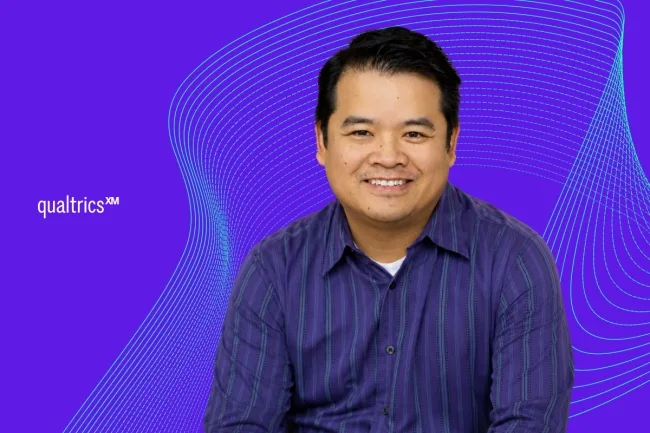
The experience management leader taps a 30-year enterprise data veteran to unify product management and design—and frames the appointment around a platform thesis that data, not models alone, will close the “Experience Gap.”
Qualtrics has promoted Ken Hoang to Senior Vice President, Product, placing a veteran enterprise-data architect at the center of its effort to turn experience management into a faster, more intuitive AI engine for its customers.
In the expanded role, Hoang will lead Qualtrics’ combined Product Management and Design organization, with a mandate to accelerate the next generation of AI-driven capabilities the company is building for experience management (XM)—the category Qualtrics created and continues to steward across roughly 19,000 customers worldwide.
A Data-Platform Pedigree for an AI Moment
Hoang brings a three-decade track record built specifically around data and AI infrastructure—an increasingly relevant profile as XM shifts from collecting feedback to acting on it autonomously. He was an early mover in enterprise AI, working on AI applications at Inference, and later helped define the Master Data Management category at Siperian, which Informatica acquired. He has also held senior roles at Oracle NetSuite and IBM, and brings operational depth across AI, enterprise analytics, applications, and infrastructure software.
The Platform Thesis: Data Over Models
In a blog post accompanying the announcement, Hoang laid out a vision that positions the data layer—not the model—as the decisive factor in whether AI delivers real business outcomes. His argument is pointed for CX and marketing leaders weighing where to place their AI bets: closing the gap between rising customer expectations and organizational response requires “deep human understanding and contextual inference that large language models alone can’t provide.”
That capability, in his framing, is the ability to connect a signal to a person, a moment to an outcome, and feedback to what actually matters—the layer he says organizations must prioritize if AI is to translate into results rather than just faster insight. He describes the widening distance between expectations and delivery as the “Experience Gap,” and casts closing it as where businesses win.
Hoang also makes the competitive case explicit. Qualtrics, he argues, holds an advantage no rival can claim: decades of experience data across customers and employees, now deepened by the addition of Press Ganey Forsta’s healthcare data to form what the company calls the world’s largest AI dataset for human experiential context. Paired with the right architecture, he contends, that dataset allows Qualtrics to predict what people need, simulate outcomes before they happen, and personalize at a scale competitors can’t match. He also emphasizes a design philosophy of building AI infrastructure and user experience together from the ground up—platforms he describes as both powerful and seamlessly intuitive.
Leadership Buildout Around AI Continues
The promotion extends a run of senior appointments organized around Qualtrics’ AI push under CEO Jason Maynard. In late 2025, the company named Mark Hammond SVP, Core AI, and promoted Jeff Gelfuso to Senior Vice President and Chief Product Experience Officer, unifying product, research, and user-experience design. Those moves followed the company’s $500 million AI investment commitment and its acquisition of Press Ganey Forsta, which expanded its dataset into healthcare and patient experience.
Hoang’s remit—product management and design together—signals continued consolidation of the disciplines that shape how customers actually experience Qualtrics’ AI, rather than just how it performs under the hood.
“Ken’s 30-year track record of building pioneering data and AI platforms that define industries makes him the ideal leader for this moment,” said Jason Maynard, CEO of Qualtrics. “He brings world-class expertise that will help design the future of the XM category and accelerate the value and innovation we deliver to our customers.”
Why It Matters for CX and Marketing Leaders
For enterprise buyers, leadership changes at a platform vendor preview product direction—and Hoang’s appointment reads as a signal about where Qualtrics intends to compete. His data-first thesis suggests continued emphasis on the proprietary dataset and usability layer that determine whether agentic workflows, conversational feedback, and synthetic audiences translate into measurable returns. For leaders evaluating XM and adjacent platforms, the takeaway is that Qualtrics is anchoring its next phase less on model horsepower and more on the depth of experiential data feeding it—and on making that power accessible to everyday users.