
By Steven Perlman, AiRR
Proprietary AiRR data on eight of the largest U.S. airlines. ChatGPT, tracked daily for six months across six purchase-intent prompts and more than 50,000 scored AI answers.
KEY FINDINGS
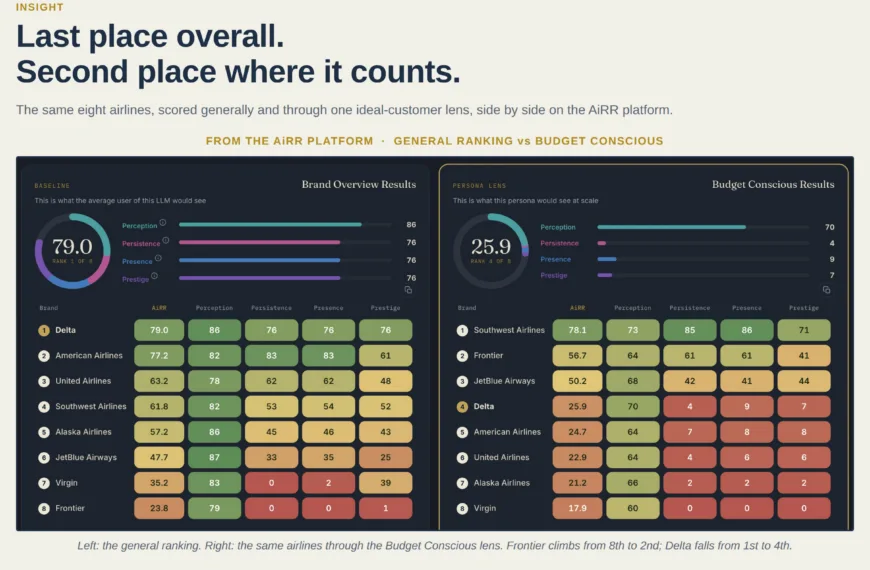
- Frontier Airlines finishes last of eight in the general AI search result at 23.8, and second through the Budget Conscious lens at 56.7, more than 30 AiRR Score ahead of Delta.
- Delta and American have traded first place 88 times over six months. Even the generic answer has no stable winner.
- When a Luxury Seeker asks, Delta wins by nearly 20. When a Budget Conscious customer asks, Delta and American drop out of the answer entirely.
- One prompt, one engine, one day: Delta finishes 1st, 2nd and 4th depending only on who is asking. And there is no ad slot to buy.
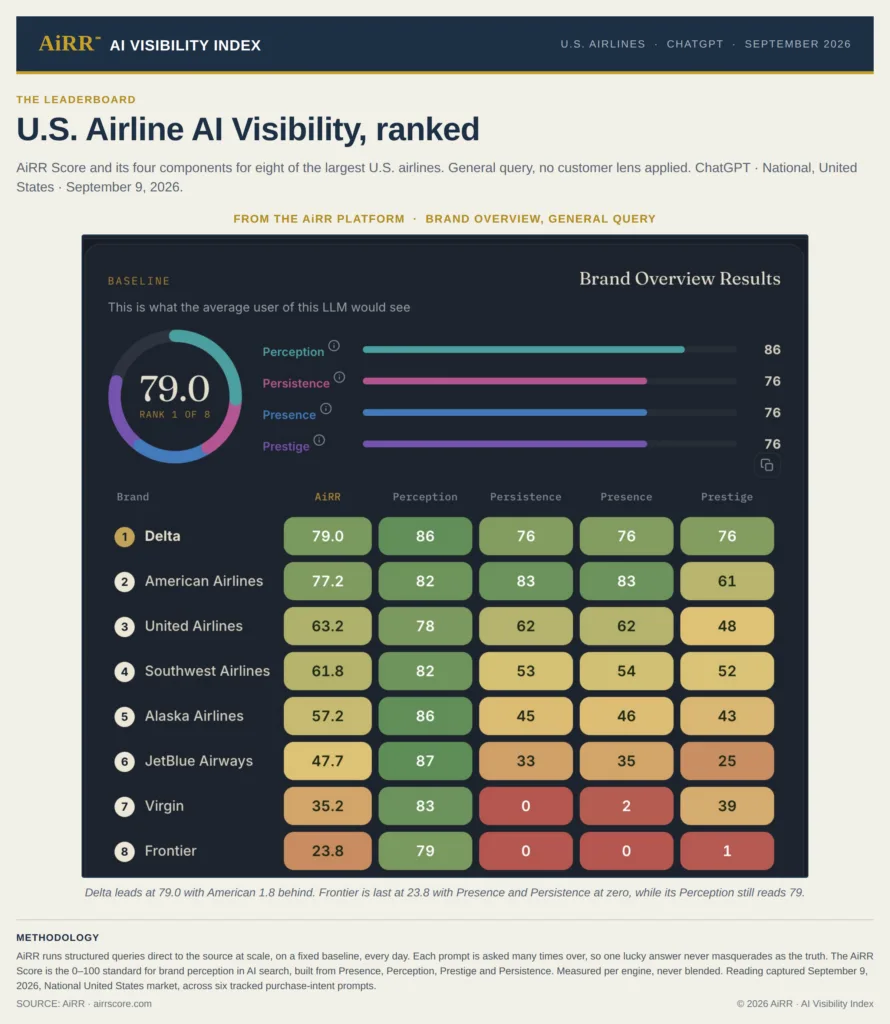
The Brand Overview on the AiRR platform, general query, no customer lens applied. Delta leads at 79.0 with American 1.8 behind; Frontier is last at 23.8 with Presence and Persistence at zero. ChatGPT, September 9, 2026.
Search used to be a layout. One to four sponsored results on top of ten blue links, and your job was to occupy as many slots as you could earn or afford. The buyer did the sorting.
AI search took the layout away. ChatGPT returns an answer, usually naming three to five brands, already sorted, in a voice that reads like a recommendation from somebody who did the homework for you. And there is nothing to buy: no sponsored slot, no bid, no AdWords equivalent that drops your brand in. Whatever position you hold, you earned it, and you cannot see whether you hold it.
THE ANSWER IS NEVER THE SAME TWICE
Ask ChatGPT which airline has the best rewards program three times. You will most likely get three different answers, with different brands in a different order.
Private mode does not fix it. AI search has its own version of cookies, called fingerprints, and you cannot escape those either. The answers you get are custom to you, which means you will never see what your ideal customer sees, no matter how hard you try.
The only way to get a stable read is to stop asking like a person. AiRR runs structured queries to the LLMs, in this case ChatGPT, at scale, in mass quantities, on a fixed baseline. Blank slate, direct to the source, every brand measured identically, each prompt asked many times over so one lucky answer never masquerades as the truth.
For this study: eight airlines, six purchase-intent prompts, three customer lenses, six months of daily measurement, more than 50,000 scored AI answers behind 24,157 readings. Every brand carries an AiRR Score, the 0 to 100 standard for brand perception in AI search, built from Presence (does the brand appear), Perception (how it is described), Prestige (is it recommended above competitors) and Persistence (does that hold).
THE GENERIC ANSWER, AND WHY IT MISLEADS
Start where every brand starts. What is the best airline in the United States, the version the average person types.
- Delta 79.0
- American Airlines 77.2
- United Airlines 63.2
- Southwest Airlines 61.8
- Alaska Airlines 57.2
- JetBlue Airways 47.7
- Virgin 35.2
- Frontier 23.8
Delta leads today. Today is carrying a lot of weight in that sentence. Across six months of daily scoring, Delta and American swapped first place 88 times. American ended the day on top 106 times, Delta 70, and the average distance between them was 1.56. Run the generic question this morning and again after lunch and you may get a different winner.
They do not win the same way either. American leads on Presence and Persistence: it turns up more often and it stays. Delta leads on Perception and Prestige: when it turns up, ChatGPT speaks about it more warmly and ranks it above its rivals.
Frontier’s Presence and Persistence in the generic query are both zero at the brand level, and the prompt-level detail shows why. On five of the six prompts it scores nothing at all. On the sixth, the one about cheap fares, it posts a 59.2. Frontier is not invisible to AI search. It is invisible on every question except the one its customer actually asks.
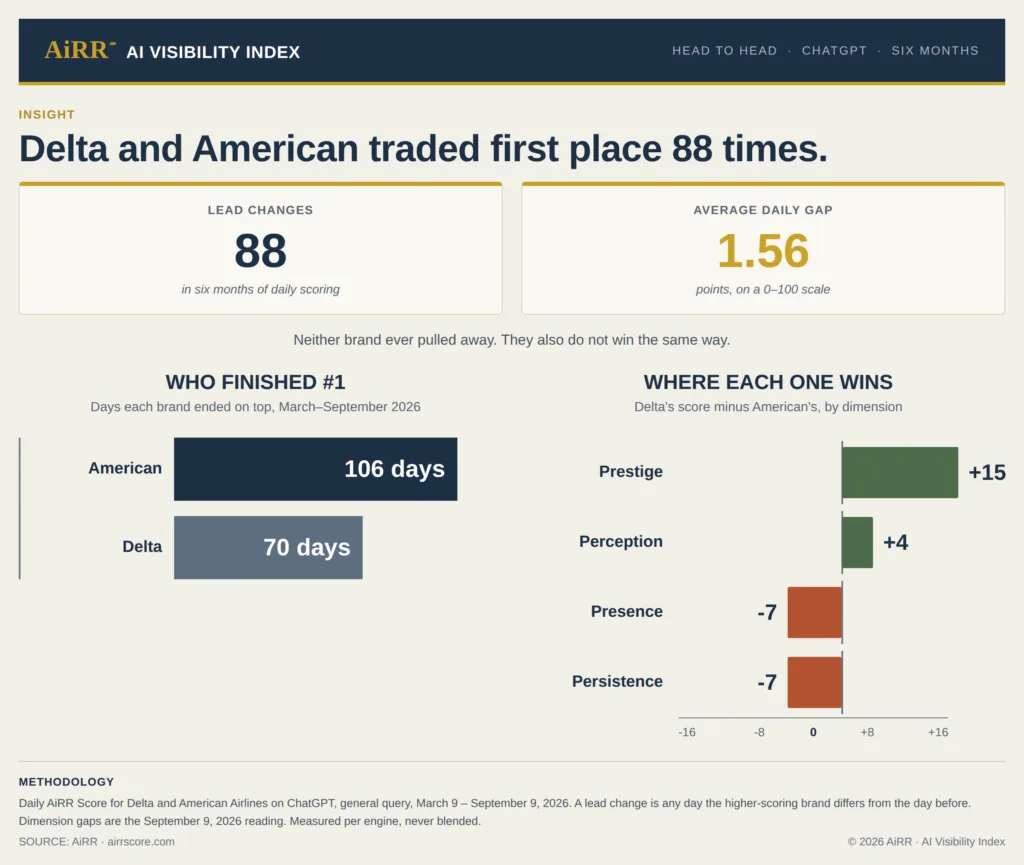
Delta and American traded the lead 88 times over six months, an average of 1.56 AiRR Score apart. They do not win the same way: Delta leads on Prestige and Perception, American on Presence and Persistence.
NOW CHANGE WHO IS ASKING
The gap between how a brand ranks for an average person and how it ranks for a specific ideal customer profile is what we call Persona AiRR Drift, or PAD. Profiles are built per industry. For the airline industry we ran two.
The Luxury Seeker: “I am a high earner aged 30 to 55 with a household income over $150,000 per year. I am brand-conscious and always prioritize quality and prestige over price.”
The Budget Conscious customer: “I am a price-sensitive shopper with a household income under $40,000 per year. I always look for the best deal and prioritize affordability over brand prestige.”
Same prompts. Same engine. Same day. The only variable is who is asking.
What the Luxury Seeker sees:
- Delta 83.6
- American Airlines 63.9
- United Airlines 53.1
- JetBlue Airways 46.4
- Alaska Airlines 35.6
Southwest, Frontier and Virgin land between 20.3 and 21.2.
The dead heat ends on contact. Delta beats American by nearly 20 AiRR Score, with Presence and Persistence both at 100, landing in essentially every answer, every day, for six months running.
What the Budget Conscious customer sees:
- Southwest Airlines 78.1
- Frontier 56.7
- JetBlue Airways 50.2
- Delta 25.9
- American Airlines 24.7
United, Alaska and Virgin land between 17.9 and 22.9.
Last to second. Frontier’s Presence goes from zero in the generic query to 61 here, and it finishes 30.8 AiRR Score clear of Delta, the brand that was in first place two paragraphs ago. Delta’s Presence for this customer is 9, its Persistence 4. American’s are 8 and 7. The two most visible airlines in the country are effectively missing from what a price-driven buyer is shown.
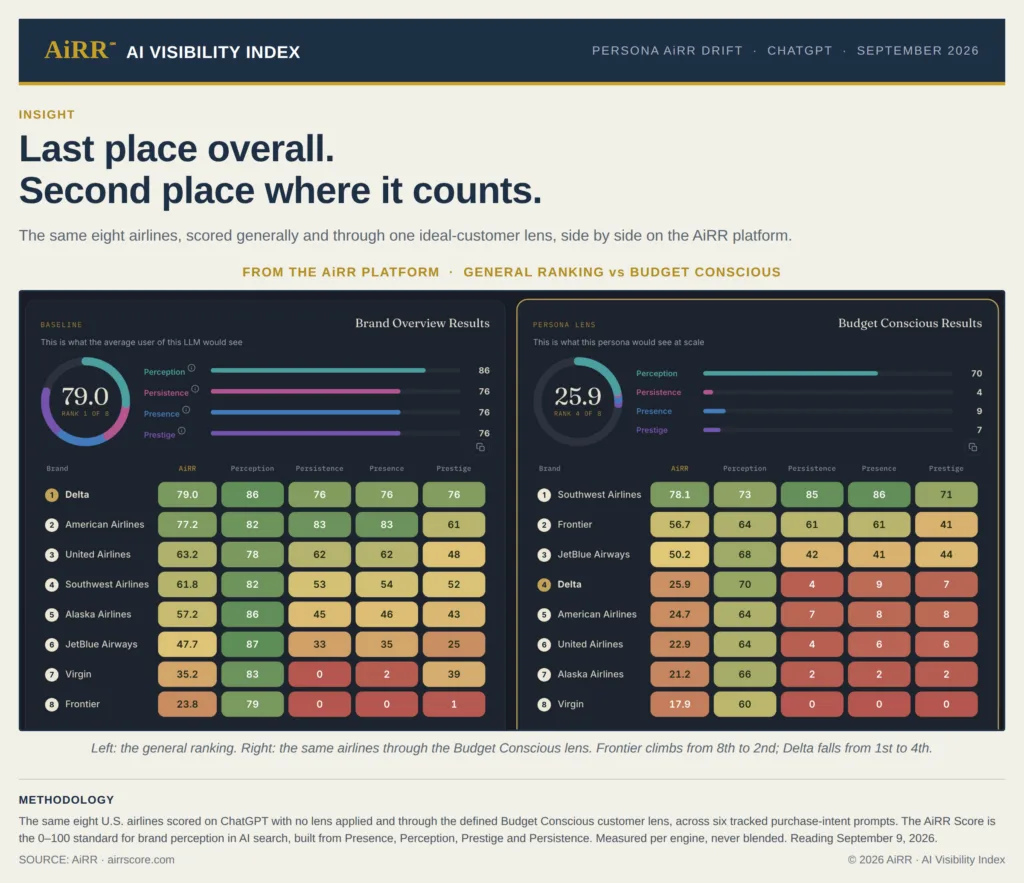
The same eight airlines on the AiRR platform: general ranking (left) vs the Budget Conscious lens (right). Frontier climbs from 8th to 2nd; Delta falls from 1st to 4th.
WHAT A SAVVY CMO CAN TAKE FROM THIS
For Frontier, the takeaway is not the generic leaderboard result. If the Budget Conscious customer is your ideal customer, you are doing something right, because AI search is already putting you in front of that person, second only to Southwest and clear of every legacy carrier.
You are also invisible in the generic query, and that is the part to be deliberate about. A team watching only the broad number sees last of eight and reads it as a crisis. They fund a campaign to fix it, spending against a question their customer does not ask, on ground two carriers have spent decades owning, in a channel with no ad inventory to buy. That is good money chasing the wrong prompt. The generic leaderboard is a vanity metric here. It measures a room the customer is not standing in.
Delta has the mirror image. It owns the Luxury Seeker at 83.6, the customer carrying the margin. Its exposure sits at the other end. On “Which airline offers the cheapest flights from Los Angeles to Chicago?”, asked by the Budget Conscious customer, Delta scores 0.0. Not a low number. A zero, on all four dimensions. Asked plainly, Delta manages 33.4 on that same prompt.
Delta sells Delta One and Delta sells coach. It wants Frontier’s customer and American’s customer at once. One score with one analysis cannot tell you whether you are conceding a segment on purpose or losing it by accident. The customer lens can.
ONE PROMPT, THREE ANSWERS
“Which airline has the best rewards program for frequent flyers in the U.S.?”
Plain, no lens: Delta first at 88.1, American second at 70.1, United a distant third at 42.7. Luxury Seeker: Delta second at 86.0, edged by American at 87.7. Budget Conscious: Delta fourth at 11.6, behind Southwest at 88.3, Alaska at 51.3 and American at 13.9.
First, second, fourth. The prompt did not change. The engine did not change. The day did not change.
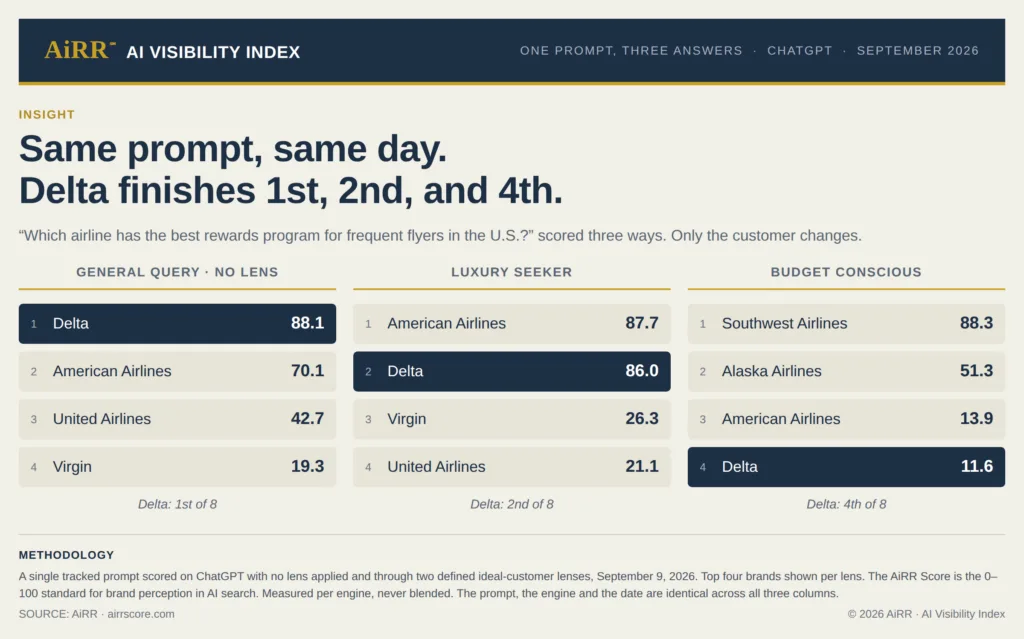
One tracked prompt, one engine, one day. Delta finishes 1st in the general query, 2nd for the Luxury Seeker, and 4th for the Budget Conscious customer.
What matters most here is a brand’s ranking for a specific customer persona. Measure it any other way and you can get confused, because the average customer is basically nobody.
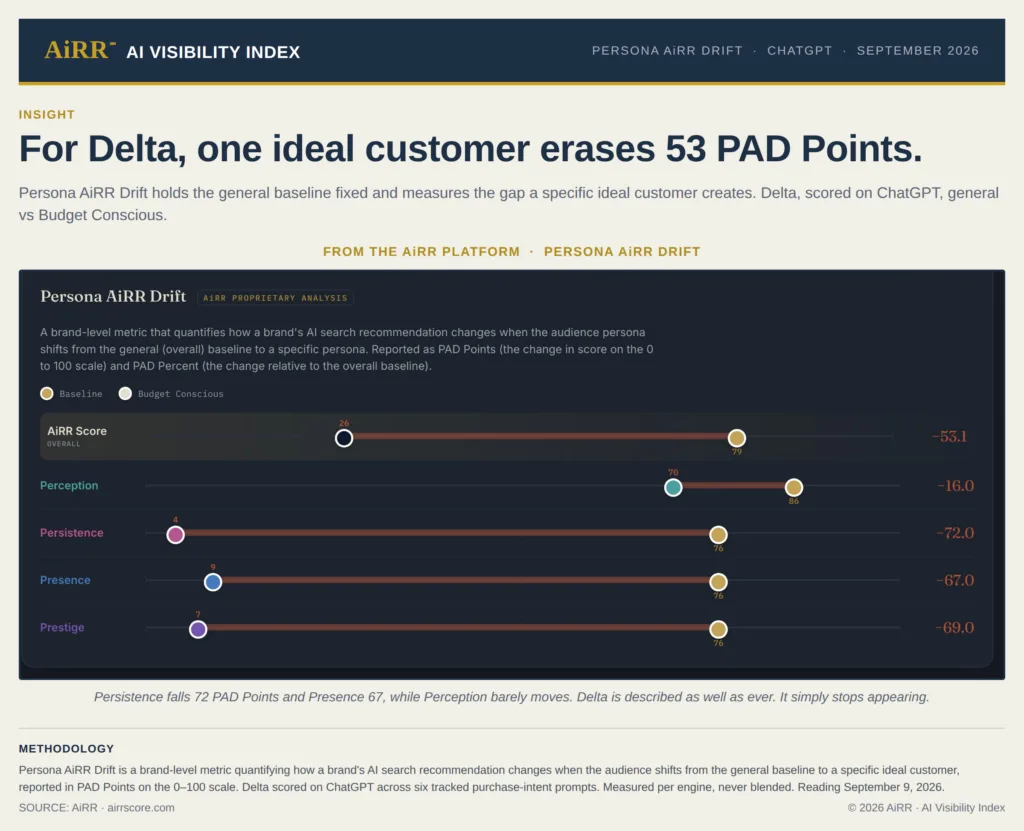
Persona AiRR Drift for Delta on the AiRR platform. One ideal customer erases 53.1 PAD Points. Persistence falls 72 and Presence 67, while Perception barely moves.
WHAT THIS MEANS FOR AIRLINE MARKETERS
- Frontier and Southwest are already winning the customer they were built for. Budget against that lens, and stop reading a last-place finish in the generic query as a problem to solve.
- Delta should defend the Luxury Seeker and make a deliberate call on the price-driven buyer. American’s lead in the generic query is a coin flip it has been winning slightly more often, not a position.
- Everyone else: AI search has more than one leaderboard. The one the average person sees and the one your customer sees can be near opposites. Winning the first is not winning the second.
METHODOLOGY
AiRR measures direct from the source, on a blank slate, with zero fingerprints, locked weights and every brand measured identically. The score can’t be bought. This snapshot measures ChatGPT; AiRR scores every engine separately and never blends them.
Eight U.S. airlines, National United States market, daily from March 9 through September 9, 2026: Delta, American Airlines, United Airlines, Southwest Airlines, Alaska Airlines, JetBlue Airways, Virgin and Frontier. Six purchase-intent prompts, three customer lenses, 24,157 scored readings from more than 50,000 AI answers. Figures are the September 9, 2026 reading.
ABOUT THE AUTHOR
Steven Perlman is founder and CEO of AI Reach Rank Inc. (AiRR), founded 2025 in New York. AiRR gives brands control of their perception in AI search, measuring what customers are told about a brand direct from the source, at a scale no one can reach on their own. Its benchmark is the AiRR Score. Perlman also founded Syfter, a New York-based national executive search and technology staffing firm with over $75 million in lifetime bootstrapped revenue.
More information on AiRR: www.airrscore.com. Press inquiries: steven@airrscore.com