
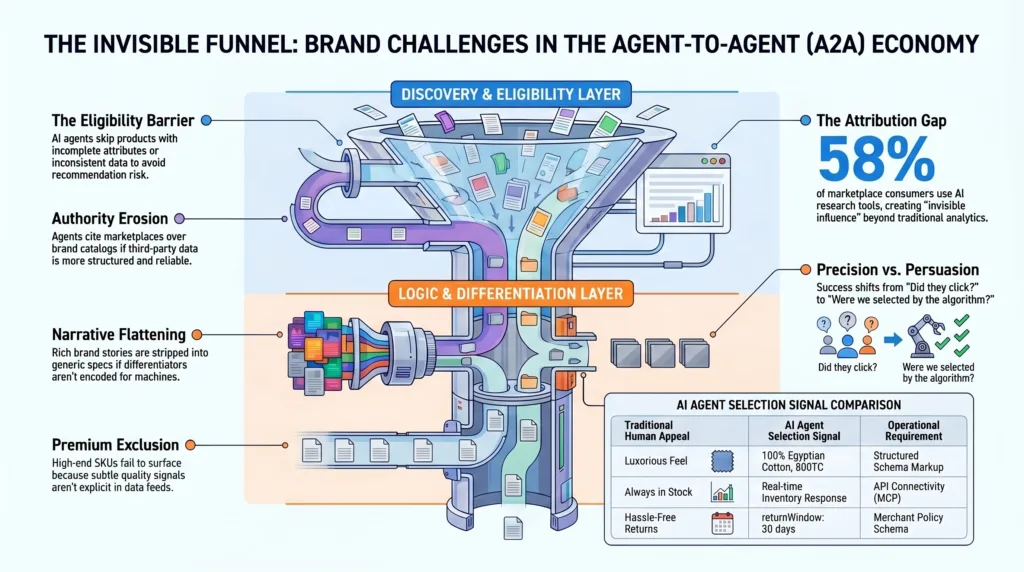
AI agents now perform a growing share of the research, comparison, and purchasing that consumers once did themselves. When an agent handles that work, it assembles a shortlist before the customer reviews anything, and it does so by reading structured product data rather than marketing language. The practical consequence is that a brand can be excluded from consideration with no corresponding signal in its own analytics: no traffic decline, no campaign failure, nothing obvious to investigate.
This is measurable rather than speculative. Adobe Analytics recorded generative-AI-referred traffic to US retail sites growing roughly 690% year over year across the 2025 holiday season (Adobe Analytics, 2026). McKinsey estimates conversion from AI-generated product recommendations at about 4.4 times that of traditional search (McKinsey, as cited in MetaRouter, 2026). Capgemini’s consumer research finds that 58% of consumers have already replaced traditional search engines with generative-AI tools as their primary route to product recommendations (Capgemini Research Institute, 2025). Discovery and comparison are moving from the search bar and the branded storefront into the agent interface.
Most brands are still optimizing for the wrong reader. The work that earns attention from a human shopper — narrative, design, persuasive merchandising — is largely invisible to the system that now determines whether the brand reaches that shopper at all. The Brand Visibility for Agentic Commerce (BVAC) Framework is a diagnostic for the surface an agent actually evaluates: what it can resolve, what it can compare, and what it will trust.
Where the decision now forms
The stages of the funnel still exist; they have been compressed into a single interaction the customer does not observe. The agent interprets intent, filters the field, and returns a small set of purchase-ready options. Whatever is in that set constitutes the consideration set. Whatever is outside it is, for that purchase, absent.
This produces no visible failure for the excluded brand, which is why it is easy to miss. Stibo Systems describes the effect as decision invisibility: a brand is filtered out before a human is involved, so there is no bounce-rate change and no campaign to diagnose (Molino Sánchez, 2026). Semrush characterizes the same problem from the measurement side as the attribution gap — discovery and comparison occur inside the agent, the customer arrives later through a direct or organic path if at all, and the influence that drove the decision leaves no trace in the merchant’s analytics (Hanna, 2026). The framework’s first design choice follows from this: it evaluates the data surface the agent reads, not the human-funnel metrics that no longer capture the decision.
Prerequisites: identity and attributes
Before an agent can weigh anything a brand would consider strategic, it must resolve two questions: which brand this is, and which product it is evaluating. An agent that cannot resolve a brand to a stable entity, or cannot match a product across the brand’s site, its feeds, and a marketplace, defaults to whatever it can resolve — typically a marketplace listing — or omits the brand entirely. Agents are built to be risk-averse, and an unmarked return policy or an identifier that drifts between channels is sufficient reason to recommend an alternative.
The framework treats these as prerequisites: Identity Legibility and Attribute Completeness. They are not competitive levers but the conditions under which competitive levers function. They also operate as a ceiling. The effective score on every strategic dimension is capped at the lower of the two prerequisite scores, so strong work above this line does not register until the line itself moves.
The strategic dimensions and the prerequisite cap
Six strategic dimensions sit above the prerequisites: Differentiation Encoding, Brand-Agent Representation, Trust Signal Density, Protocol Readiness, Latency and Data Freshness, and Governance Maturity. Together they cover whether a brand’s differentiators exist as queryable fields, whether it operates an agent of its own, whether its trust surface is machine-readable, whether its protocol stack functions and responds in machine time, and whether the operating model that maintains all of it is owned.
The implication brands tend to resist is the cap. A brand can encode its differentiation precisely — every claim structured, every premium signal backed by a verifiable source — and still score no higher than Discoverable in effect, because Attribute Completeness beneath it sits at Discoverable. The diagnostic score will indicate excellent work; the effective score reflects that the agent never reached it. The framework names the most common version of this the premium quality trap: a page rich in evaluative language with nothing an agent can query against, so the agent falls back to the attributes it can read — price and basic specifications — and a premium SKU is ranked against products that were never its peers. The more frequent and more expensive error in practice is investment in a strategic capability while a prerequisite remains unaddressed: a quarter spent standing up an agent initiative while the return policy stays unmarked in unstructured HTML, invisible to the models deciding whether to surface the product at all.
The persuasion penalty
Differentiation Encoding has a less obvious failure mode that inverts a long-standing marketing assumption. Persuasion cues built for human psychology — scarcity badges, countdown timers, aggressive discount framing — carried into agent-readable surfaces are not interpreted as persuasion. More capable reasoning models tend to treat them as low-quality or manipulation signals and discount the listing accordingly, and the effect strengthens as models advance.
The evidence is direct. Sabbah and Acar tested eight standard promotional mechanisms across four models and more than 16,000 simulated purchase decisions for a 2026 Harvard Business Review study. One signal — structured ratings — moved selection upward consistently across every model and product category. Strike-through pricing, countdown timers, and bundling showed no stable pattern, and bundling reduced selection in at least one case. The reasoning models were the more skeptical, in several cases appearing to penalize overt persuasion as a quality signal in itself (Sabbah & Acar, 2026). The operational conclusion is that a promotional layer many merchandising teams treat as costless can suppress selection on the surface an agent reads, and the framework scores it as a Differentiation Encoding failure.
This is also where the framework’s scope on price is most often misread. The framework evaluates whether price is legible, structured, and current enough for an agent to use. It does not evaluate whether the price is competitive. Price competitiveness is a merchandising decision that sits upstream of anything the framework measures; the persuasion penalty concerns the promotional treatment around the price, not the price itself.
The trust-signal floor
One strategic dimension behaves differently from the others. Trust Signal Density operates as a graded competitive surface above a threshold and as an eligibility gate below it. Below the gate — no structured Review entities, no certification surface in schema, no sameAs links to third-party authority sources — Trust Signal Density does not merely score low; it caps every other strategic dimension at Discoverable. Protocol work, differentiation work, and an owned agent are all held at Discoverable until at least one of those trust signals exists.
The gate requires that some trust surface exist rather than a specific one, because trust signaling works through redundancy and categories distribute it differently: B2B buyers weight certifications and references, commodity buyers weight review volume. Requiring a single signal type universally would fail at the first category boundary. The stakes are not marginal — in the Sabbah and Acar testing, structured ratings were the one signal that consistently moved agent selection across every model and category (Sabbah & Acar, 2026). A brand with a clean catalog and no trust surface remains eligible for inclusion and is deprioritized at ranking, consistently. The floor is therefore among the lowest-cost, highest-leverage interventions in the model: crossing it is frequently a single schema action that removes a cap from the entire strategic tier.
A worked example
Consider a mid-market apparel brand with a strong product, genuine reviews hosted on a third-party platform, a marketing team that can articulate the product’s advantages, and a catalog that largely cannot.
Identity Legibility scores Comparable. Attribute Completeness scores Discoverable: core fields are present, but there is no MerchantReturnPolicy markup and several category-standard attributes are missing. Trust Signal Density is below the floor — the reviews exist but not as structured Review or AggregateRating entities, with no certification schema and no authority anchors. Differentiation Encoding scores Differentiated on its own merits, because the structured differentiators are good; the catalog, however, also carries scarcity badges and countdown urgency into those same structured surfaces, which the reasoning models discount.
The composite score is Invisible. Read against the diagnostic, the gap is the lesson. The differentiation work returns nothing in effect: the floor caps the strategic tier at Discoverable, and Attribute Completeness caps it again, independently. The two highest-leverage actions are both achievable within a quarter, and neither is the agent initiative the team expected to discuss — mark up the return policy in MerchantReturnPolicy to move the binding prerequisite, and implement Review and AggregateRating schema against the existing reviews to cross the floor and remove the Discoverable cap from the entire strategic tier. The resulting roadmap is not a long list of gaps sorted by horizon; it is a short instruction to complete those two items first, because the remaining work returns nothing until they are done.
Where to start
Sequence matters more than any single dimension. Begin with the prerequisites, assessed against the structured data rather than the marketing site. For the top 20 SKUs by revenue, determine whether an agent can resolve the brand and product to stable entities and whether category-standard and policy attributes are present in the markup. Then assess the floor: whether structured Review entities, a certification surface, or sameAs authority anchors exist anywhere in the catalog. If they do not, that is the first body of work, ahead of any agent roadmap. While doing so, remove scarcity badges, countdown timers, and discount framing from agent-readable surfaces and observe the effect on a reasoning model; reducing persuasion is one of the few changes that costs nothing and can raise selection within the same quarter. Only after the prerequisites move and the floor is crossed is it productive to sequence the remaining strategic work, and that sequence should follow whichever dimension is constraining the composite, not whichever has the most internal attention.
The customer who never loads the homepage is already shopping, and the agent acting on that customer’s behalf is assembling its shortlist from the data it can read and trust. The relevant question for any brand is whether its data currently earns a place in that set. The framework exists to answer that question deliberately, rather than leaving it to be answered by omission.
References
Adobe Analytics. (2026). AI-driven traffic surges across industries, retail sees biggest gains [2025 holiday shopping recap]. Adobe.
Capgemini Research Institute. (2025). What matters to today’s consumer (4th ed.). Capgemini.
Hanna, C. (2026). Attribution gap in agentic search: How to close it. Semrush.
MetaRouter. (2026). Agentic commerce trends and statistics for 2026. MetaRouter. (Conversion figure attributed to McKinsey.)
Molino Sánchez, M. (2026). 7 signs your brand is losing ground in agentic commerce. Stibo Systems.
Sabbah, J., & Acar, O. A. (2026, May 12). Research: Traditional marketing doesn’t work on AI shopping agents. Harvard Business Review.
About the Author
Greg Kihlström is a MarTech futurist, best-selling author, speaker, entrepreneur, and advisor who helps leaders understand where marketing technology, customer experience, and AI-mediated execution are heading next, and what their organizations need to change now to keep up.