In this episode
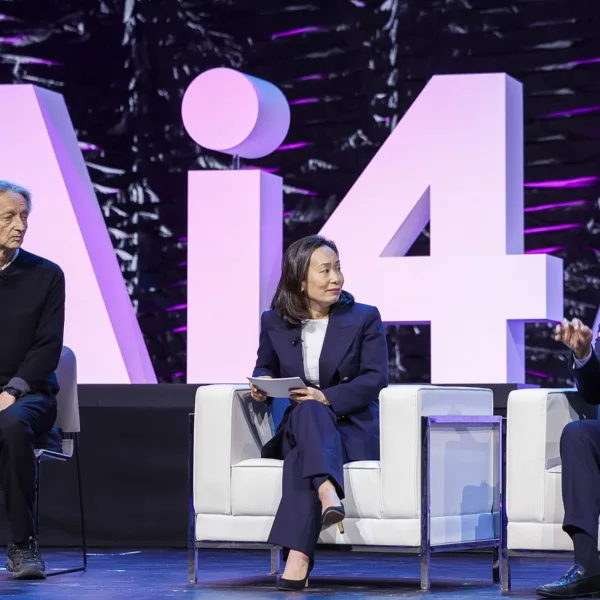
Taryn Crouthers, CEO of Big Spaceship — MSQ Partners’ creative agency — joins Greg Kihlström live from Ai4 2026 in Las Vegas to draw a specific line between where AI sharpens creative work and where it creates unacceptable brand risk. Nine months into the CEO role, Crouthers argues that the useful question is never “should we use AI” but “to what end” — and that the answer changes the implementation entirely. The conversation covers how generative tools have changed storyboarding, creative testing, and post-production (including removing rain from a shoot after the fact), how her agency protects client IP through closed systems and written AI addendums, how she measures AI internally by the quality of her team’s time rather than hours saved, and why agency pricing is moving away from time and materials now that a deliverable can take “30 seconds and 30 years.”
Key takeaways
- The first question about any AI implementation is intent, not tooling. Crouthers pushes partners to answer “to what end” — better creative, cheaper production, lower staffing costs, or customization that wasn’t previously possible — because the recommendation changes completely depending on the answer.
- 2024 and 2025 were about doing creative work faster and cheaper; 2026 conversations are about doing it better. The efficiency framing has been replaced by an output-quality framing in client discussions.
- Generative storyboards remove the leap of faith from creative testing. Audiences and CMOs now evaluate something close to the finished product rather than a sketch, which makes both approvals and test results more reliable.
- The mandate to the team is not to spend less time, but to spend time where it changes the result. Time freed from storyboarding goes to connecting ideas differently and accommodating work that wouldn’t have fit the scope.
- Bad ideas can now fail cheaply. Visualizing a concept before production means ideas get abandoned on evidence rather than after an expensive commitment.
- Production constraints that used to cost a shoot day are now post-production problems. On a complicated outdoor shoot that got rained out, Big Spaceship filmed anyway and removed the water, changed the sky, and adjusted lighting with generative imagery afterward.
- Ownership is protected structurally, not contractually after the fact. The agency ideates inside closed systems, uses only tools that don’t learn off other models, and tracks prompts — because as the agency it is responsible for both input and output, including indemnification.
- Every agency–client relationship should open with a written AI addendum. Crouthers recommends documenting tools, comfort levels, and boundaries before the partnership starts rather than negotiating them mid-project.
- The internal measure of AI is the quality of the team’s time. She identifies the tasks that drain energy, automates them, and uses tools like Claude to analyze time-tracking reports that previously required a department to interpret.
- “Thirty seconds and thirty years” is the pricing problem. When a creative director’s output reflects decades of craft compressed into a prompt, time-and-materials scoping stops measuring value — which is why more scopes now blend deliverables and upside.
- Infinite revisions mean the work isn’t necessarily faster. Because post-production changes are now effectively unlimited, each tweak restarts the workflow, and timelines haven’t compressed the way the tooling suggests they should.
Chapters
- 0:00 — Which decisions still belong to a human?
- 1:50 — Taryn Crouthers, CEO of Big Spaceship
- 2:52 — From film-to-digital to AI: why she took the job
- 5:42 — “To what end?” — the question before any AI deployment
- 6:36 — Efficiency was 2024–25; 2026 is about doing it better
- 8:39 — Storyboarding, creative testing, and insight work
- 10:16 — Augmentation, not automation: spending time on impact
- 11:56 — Removing rain in post: what AI changes about production
- 13:28 — Ownership and accountability in a closed system
- 15:31 — Why every agency should write an AI addendum
- 16:04 — Measuring AI internally: automating the tasks that drain the team
- 18:12 — “30 seconds and 30 years”: pricing beyond time and materials
- 19:43 — Why infinite revisions don’t make work faster
- 21:12 — Ai4 takeaways and staying agile
Why “to what end” is the only useful first question about AI
Crouthers treats AI adoption as a strategy problem rather than a tooling problem. When a partner says they want to implement AI, her response is to ask what outcome they’re buying: better creative, cheaper production, reduced staffing cost, or personalization that wasn’t previously feasible. Each answer produces a materially different recommendation and implementation. Skipping that step is how brand risk enters the process unnoticed — because a system that ships work autonomously and a tool that accelerates a human’s first draft get described with the same three letters.
What changes when a storyboard is generated instead of drawn
Traditional storyboarding required a dedicated artist and significant back-and-forth, and still left CMOs presenting abstractions to their boards. Generative storyboards are lifelike enough that stakeholders can judge whether the investment is worth making. The same shift improves creative testing: instead of asking audiences to imagine the finished work, testing now shows something close to it, which Crouthers says makes the quality of the test itself substantially stronger. On the strategy side, teams comb through more data and surface human truths faster, reaching differentiated creative territory earlier.
Where AI moved from pre-production into production
The clearest example Crouthers gives is a complicated outdoor shoot that rained. Under the old economics, that meant postponing, adding a shoot day, and absorbing crew and production costs. Instead the team filmed through it and removed the water afterward, along with adjusting the sky and lighting. She also points to asset versioning: productions used to yield a finite number of assets, and now the constraint is effectively gone, which is pushing the agency to think in campaign and creative models rather than deliverable counts.
How ownership stays clear when humans and AI both touch the work
Accountability blurs easily, so Big Spaceship handles it structurally. Ideation happens in closed systems, generative tools used for partners are restricted to those that don’t train on other models, and prompts are tracked so ownership is documented. The ideas, research, and writing originate with the creative team; AI supplements rather than authors. Because the agency carries responsibility and indemnification for both input and output, Crouthers treats this as a non-negotiable operating condition rather than a policy preference — and recommends every agency and client formalize it in an AI addendum before work begins.
Why AI is breaking the time-and-materials model
Agency compensation was historically priced on time. When a creative director answers “how long did that take” with “thirty seconds and thirty years,” the model stops describing the value being delivered — the thirty seconds is the prompt, the thirty years is the judgment that made the prompt good. Crouthers says she’s now seeing more scopes negotiated on deliverables and upside rather than hours. The complicating factor is that the work isn’t reliably faster: because partners can now change an outfit or remove rain at will, revision cycles have expanded to fill the space the tooling created.
How Crouthers measures whether AI is actually helping
Externally, campaigns are still judged on marketing KPIs. Internally, the metric is the quality of her team’s time. She looks for the tasks that don’t give people energy, automates them, and redirects that capacity toward work that builds skills and improves output. Because the agency tracks time by role and discipline, she can pull reports and identify workflow opportunities — analysis that once required a department and now runs through tools like Claude. She pairs tool access with training programs, on the view that distributing tools without teaching them doesn’t change anything.
FAQ
What question should a brand answer before implementing AI in creative work? What outcome the AI is meant to produce. Taryn Crouthers asks partners “to what end” — better creative, cheaper production, lower staffing costs, or new customization — because the recommendation and implementation differ completely depending on the answer.
How has AI changed creative testing? It removed the leap of faith. Generative visuals let test audiences and internal approvers evaluate something close to the finished work rather than a rough sketch, which makes test results and approval decisions more reliable.
How do agencies protect client IP when using generative AI? By working in closed systems, using only tools that don’t learn from other models, and tracking prompts so ownership is documented. The agency remains responsible for both input and output, including indemnification.
What is an AI addendum, and why does Big Spaceship use one? It’s a written agreement attached to a client partnership that documents which tools can be used, where the client’s comfort levels sit, and where the agency can push. Crouthers recommends every agency-client relationship start there rather than resolving the questions mid-project.
Does AI make agency work faster? Not reliably. Because post-production changes are now effectively unlimited, each revision restarts the workflow, so timelines often don’t compress even when individual tasks do.
How does AI change how agency work should be priced? It weakens time-and-materials scoping. Crouthers cites the line “thirty seconds and thirty years” — the prompt is fast, the expertise behind it isn’t — and says more scopes are now negotiated on deliverables and upside rather than hours alone.
About Taryn Crouthers
Taryn Crouthers is the CEO of Big Spaceship, MSQ Partners’ award-winning creative agency. A passionate leader, Taryn has spent her decades-long career inspiring teams to create work that moves both people and business. Her work spans advertising, media, entertainment, and the distribution and commercialisation that scale them. She is the former President of social-first global media company ATTN:, where she helped lead the company from pre-revenue through its $100M acquisition.
Along the way, she earned recognition including Campaign’s Inspiring Women (2026), 40 Over 40 (2025), Ad Age Leading Women (2024), Cynopsis’ Corporate Visionary, and Top Women in Digital.
An entrepreneur at heart and a nationally recognised voice on the future of creativity and AI integration, Taryn brings a founder’s mindset to scaling creative businesses and developing new revenue models. She has served on juries for Cannes Young Lions, The One Show, ADC, Webby Awards, and other prestigious industry competitions. She serves on the Advisory Board of Miami Ad School and is an active investor in emerging creative and technology-driven companies.
She is also a co-founder of the Women in AI Summit for the Creative Community and launched the Women in AI Creative Cohort, which selects 15 top global executives for a six-month AI mentorship program.
Taryn Crouthers on LinkedIn
———- Resources ———-
The Agile Brand podcast is brought to you by TEKsystems.
We’re proud to be a media partner for #MAICON26 – Oct. 13-15! Learn how AI can power your marketing and business and help you grow smarter. Use code AGILE150 to save!
Reach your customers with Reddit. Spend $500 in ad spend, get $500 back in ad credit!
Chaser is the only Slack-native project management platform that helps teams turn messages into tracked tasks, automate follow-ups, and maintain team-wide visibility, without adopting another tool. Now integrated with Claude and other GenAI tools. Learn more at trychaser.com and use code AGILEBRAND for a 3-month free trial (normal trial is 14 days).
The most influential minds in software, AI, and engineering leadership will be at WeAreDevelopers World Congress North America, September 23-25 in San Jose.
Start building your own apps with Replit and get $20 off.
Enjoyed the show? Tell us more at and give us a rating so others can find the show.
Don’t miss a thing: get the latest episodes, sign up for our newsletter and more.
Check out The Agile Brand Guide website with articles, insights, and Martechipedia, the wiki for marketing technology.
The Agile Brand is produced by Missing Link—a Latina-owned strategy-driven, creatively fueled production co-op. From ideation to creation, they craft human connections through intelligent, engaging and informative content.
Transcript
[00:00:01] Greg Kihlström: Hi. I’m Greg Kihlstrom, host of The Agile Brand, and here’s a question for you. When a brand says it used AI, that could mean anything from a tool speeding up a human’s first draft to a system generating and shipping work on its own, and almost all of the real risk lives in the difference. So as AI moves deeper into creative work, which decisions are you still certain belong to a human? Real agility here isn’t being quick with the latest tools, it’s moving fast without losing the through line that makes a brand recognizable, the ability to know exactly where human judgment stays non-negotiable. Today, we’re recording live at AI4 2026 in Las Vegas at The Venetian, and we’re going to talk about drawing a clear line between where AI sharpens
[00:00:46] Greg Kihlström: creative work and where it introduces unacceptable brand risk, a practical look at how AI was used, to improve the creative process, not just automate it, and the strategic shift as consumers move from traditional search engines to AI-powered platforms for discovery and research. [Instrumental music plays] Welcome to season eight of The Agile Brand Podcast. This season, we’re going all in on expert mode MarTech, AI, and customer experience, talking with the people and platforms behind the brands you know and love. Again, I’m your host, Greg Kihlström, and I help Fortune 1000 companies make sense of MarTech, AI, and marketing ops. Hit subscribe or follow to make sure you always get the latest episodes, and leave us a rating so others can find us as well. And make sure you check
[00:01:31] Greg Kihlström: out our sponsor, TEKsystems, an industry leader in full stack technology services, talent services, and real world adoption. For more information, go to TEKsystems.com. Now let’s dive in. To help me discuss this topic, I’d like to welcome Taryn Crothers, CEO at Big Spaceship. Taryn, welcome to the show.
[00:01:50] Taryn Crouthers: Thank you so much for having me. Exciting to be here.
[00:01:53] Greg Kihlström: Yeah. Looking forward to this. before we dive in, though, why don’t you give a little background on yourself and your role at Big Spaceship?
[00:01:58] Taryn Crouthers: Yeah, absolutely. So I am CEO of Big Spaceship. I’ve been in the chair for about nine months now, so pretty new, but I have been a fan for the agency… of the agency for, gosh, as long as, truly my entire career. The agency’s been around for about 25 years, so they’ve just always done incredible work and innovation, so excited to now be leading the very talented team.
[00:02:17] Greg Kihlström: Yeah. Yeah. I know. I’ve, I’ve been following Big Spaceship for quite a while as well, as we were talking about earlier.
[00:02:24] Greg Kihlström: Absolutely. And so, you know, we’re gonna talk a lot about AI being used in the enterprise, you know, some of your clients and then things like that. But I also wanna talk… You know, you’re, you’re relatively new to the role, nine months in as CEO, just as enterprises are going through a lot of AI transformation, agencies are also-
[00:02:43] Taryn Crouthers: Is there change happening right now?
[00:02:45] Greg Kihlström: Right. Right. I know. [laughs]
[00:02:46] Taryn Crouthers: Yeah. What now?
[00:02:47] Greg Kihlström: you know, what, what drew you to Big Spaceship and, and kind of the, the agency world here?
[00:02:52] Taryn Crouthers: Yeah. I’ve always been a builder at heart. Like, that’s just-
[00:02:55] Taryn Crouthers: … for me, kind of what gets me up every day and, and gets me up in the morning. I have a little bit of a nonlinear career, so I started at 15 or so years in TV and entertainment, then I helped build a social publisher, and then, now I’m leading a creative agency. And so for most, I would think they would be like, “Well, what is the through line there?” But I think for me it’s been helping companies navigate change through those times, and it really all… Not to get too personal, but it all kind of stems back to my parents. So they originally had, back in the day for their career, they had, a photography studio, and it was when film was switching to digital.
[00:03:34] Taryn Crouthers: And so I saw firsthand, my dad helped develop some of the first digital cameras and my mom was a digital illustrator, and I saw an entire industry really change overnight-
[00:03:43] Taryn Crouthers: … and how you could take a new tool and do infinitely better or more interesting creative work. And so obviously there’s a huge parallel to what’s happening now in creative agency world. And so that was one of the reasons why I was so excited about the role, and then you layer on top of that Big Spaceship and, you know, we’ve been doing digital innovation since the very beginning, right? Like, the first flash websites and those sorts of things. So now to have the privilege of leading a team through this next phase of change, to me, was an, opportunity I, I really couldn’t miss.
[00:04:12] Greg Kihlström: Yes. Yeah. Well, we’ll have to talk later, ’cause I was actually a photography major-
[00:04:16] Taryn Crouthers: Oh, you were?
[00:04:17] Greg Kihlström: … in the darkroom.
[00:04:18] Greg Kihlström: Like, I… Right at that, like-
[00:04:19] Taryn Crouthers: Oh, I grew up in darkrooms, so lots of-
[00:04:20] Greg Kihlström: Yeah. Right at that, like, kind of change. Well-
[00:04:22] Greg Kihlström: … like, digital cameras became a thing as I was graduating.
[00:04:26] Taryn Crouthers: Ah.
[00:04:26] Greg Kihlström: This was to date myself a little bit, but yeah.
[00:04:29] Greg Kihlström: [laughs]
[00:04:29] Taryn Crouthers: I, I grew up with all of that, and I, I think there was an entire generation of photographers who either stayed really true to-
[00:04:36] Taryn Crouthers: … kind of the craft, and then others that, accepted this new technology and, you know, sadly there was a, a pretty large divide between who was able to, to move on and have longstanding careers. And so I’m just super passionate personally now, especially around agencies, of helping kind of coach teams and certainly younger teams around the importance of learning these tools to be able to have a longstanding career.
[00:05:42] Greg Kihlström: protecting the brand? Because at the end of the day, you know, the, that- that’s a valuable thing that I think often gets overlooked in some of these efficiency conversations.
[00:05:51] Taryn Crouthers: Yeah. Whenever I think about AI and adding AI into anything, whether it’s the creative process or the process, process of how we make stuff, I always work with the team and with our partners and clients to figure out what is the intent behind the reason that we’re using AI in the first place, right? I think it’s any good strategist or problem-solver, you’re trying to understand why we’re doing it before we come up with a solution, and I think AI is no different. So if you’re talking to a partner and they wanna, say they im- want to implement AI, the question back is, to what end, right? Is it to make better creative? Is it to make something cheaper? Is it to reduce production costs? Is it to reduce staffing costs? Is it to do some s- some customization that you couldn’t do before using this technology?
[00:06:36] Taryn Crouthers: And depending on that response, of course, the outcome of, of how you recommend and implement that is infinitely different. So I think it’s asking that kind of next layer of questions. I like to think last year, certainly 2024 and, and I think most of 2025, AI and innovation was really focused on efficiency. Like, how do we do this faster? How do we do it cheaper? And now the conversations we’re having with partners is, how do we use it, but to do things better?
[00:07:23] Taryn Crouthers: And I talk to the team, right?
[00:07:24] Taryn Crouthers: It’s like, what, figuring out how to navigate through what was la- like even just a month or two ago, the tools are better, the tech is better, the generative AI is better, you know? And, and this is the worst it’s gonna be. We’re gonna figure it out from there. So I, I don’t know what that says about me, but for me it is, it is, calming, I think, because you know it’s just gonna, gonna get better from here.
[00:07:45] Greg Kihlström: Yeah, I know what you mean. I mean, I go back to the early days of the internet-
[00:07:50] Taryn Crouthers: Or social media. Anything really was new.
[00:07:51] Greg Kihlström: Yeah, it was always like, why can’t it just do that next thing? I think-
[00:07:56] Greg Kihlström: … I, I agree. I think we’re c- we’re there. We’re just-
[00:07:59] Greg Kihlström: … we’ll, we’ll be able to see over the hill in a, in a, in a year or two probably.
[00:08:03] Taryn Crouthers: I think the, the difference is it’s compounding, right? Because think of actually certainly the, the internet or social media, those are-
[00:08:10] Taryn Crouthers: … massive changes that have impacted how we go to market and business, but with AI it’s a layer deeper in everything that we’re doing, not only for us as an agency, but for all of the brands and partners that we’re working with, and the workflows. So it impacts so much that it’s just change on top of change, which I think is obviously scary for some people.
[00:08:31] Greg Kihlström: Yeah, yeah. So to talk about going beyond efficiency and to do some of the, the new things and-
[00:08:39] Greg Kihlström: … and maybe more-
[00:08:43] Greg Kihlström: can you talk a little bit about, you know, how do you use AI in the creative process? Maybe, you know, even to visualize creative ideas, things like that.
[00:08:50] Taryn Crouthers: Yeah. So there are, I mean, there are literally hundreds of ways that, we’re using AI. I’ll pick out a few.
[00:08:56] Taryn Crouthers: Some that are maybe more traditional, and then others that are, are, nuanced. So one, storyboarding, which sounds really simple, right? But any time we’re going to do a larger production, we would traditionally storyboard it. That entire process you would have a storyboarding artist, and it would take quite a bit of time and back and forth. And at the end of the day, certainly for, you know, CMOs who then have to take those storyboards up to their board to get, you know, projects approved, it’s, it’s kind of hard sometimes to visualize what that looks like. And now with generative, you can storyboard, but in such a lifelike way that I think it really helps to determine, is this an investment that I wanna make? for creative testing, same thing, where beforehand you were asking audiences to take a leap of faith. In creative testing
[00:09:42] Taryn Crouthers: now, they can see something that looks pretty darn close to what it ultimately will look like, and so I think the quality of the creative testing is so much stronger because you’re able to use generative. O- on the insights side of things, you know, our strat teams are able to comb through and analyze so much more data and find more human truth, have access to, you know, better data than they were before because a lot of these tools. So I think we’re getting to more interesting and differentiated territories faster creatively than we were. so those are just a, a few, but there’s a, there’s a lot there.
[00:10:16] Greg Kihlström: Well, that, that’s augmentation, not, y- I mean, it, it is efficient because to get a realistic sketch of a storyboard, you know, 30 storyboards would take a very long time for a human to do. So i- in a sense it’s efficiency, but it’s also just, it’s getting better results more quickly, right? Absolutely, and it, and it allows us, I think, to get to places that we wouldn’t have historically-
[00:10:41] Taryn Crouthers: … because you had time constraints, right? So if you don’t have the creative team who’s spending the time doing the storyboarding, well, then they can think of, “How can I make this output better?”
[00:10:49] Greg Kihlström: Yeah.
[00:10:49] Taryn Crouthers: “How can I do extras that I normally wouldn’t have been able to accommodate in the scope? How am I connecting dots differently?” So that’s really my kind of mandate to the team, is not necessarily how do we spend less time, but how do we spend our time in ways that are more impactful to the end result, to the audience-
[00:11:05] Taryn Crouthers: … to our clients, and the output.
[00:11:07] Greg Kihlström: And even get to things that seemed like a good idea in your head, but when you see it-
[00:11:12] Greg Kihlström: … in reality it’s, you know, we’re not, we’re not perfect, right? So yeah.
[00:11:15] Taryn Crouthers: There are lots of ideas that I feel like are left on the cutting room floor, that maybe wouldn’t have been before because you visualize it and you realize, oh, that actually, it’s okay that didn’t work, and it’s such a better, cheaper way to-
[00:11:31] Taryn Crouthers: … to really look at a, a, an opportunity, and make a decision that’s more fact-based.
[00:11:36] Greg Kihlström: Well, and for any client I would ima- like, after you invest so much in an idea, yeah, I mean, you can back out of it, but it, that’s a very expensive investment that you’re backing out of. And, you know, it’s happened before I, I’m sure-
[00:11:56] Taryn Crouthers: And that’s just up to the production process, right?
[00:11:59] Taryn Crouthers: So everything that we’ve been talking about now is part of creative development and pre-testing, but then I look at all of the opportunities where we’re using AI in production, post-production, editing, asset versioning, and that’s also where, where you used to have to have a finite number of assets that came out of a production, now it’s almost limitless. We’re really thinking in creative models and campaign models as opposed to in number of assets, and it’s, it’s definitely a different way of approaching campaign work. But it’s been really, really interesting to see. I’ll give you one example-
[00:12:33] Taryn Crouthers: … with a partner. We were on set doing a pretty complicated shoot, outdoors, and it rained, which is typical ’cause it happens. And so normally, in the old world, you would have to postpone the shoot, have an extra day, significant costs, production costs-
[00:12:49] Greg Kihlström: Yeah, yeah
[00:12:49] Taryn Crouthers: … and standing up, you know, extra team fee, all of the things. So we ended up filming and then removing the water after which is wild-
[00:12:58] Greg Kihlström: Yeah. Wow. [laughs]
[00:12:58] Taryn Crouthers: … to think about right now.
[00:13:00] Taryn Crouthers: But you could, you could change the sky, you could change the fact that the pool didn’t have droplets in the water.
[00:13:06] Taryn Crouthers: You could change the lighting and augment it all with generative imagery in a way that never would have… It would’ve been very, very cost-prohibitive before.
[00:13:15] Greg Kihlström: Yeah, yeah. I mean, maybe a still in Photoshop or something, but- not that.
[00:13:20] Taryn Crouthers: Yeah, but no any, yeah, when you, obviously when you’re talking about video as opposed to still-
[00:13:23] Greg Kihlström: Right, right
[00:13:24] Taryn Crouthers: … it’s exponentially more complicated.
[00:13:28] Greg Kihlström: I wanna talk a little bit about measurement as well, and so, a- and a- and accountability. So, you know, once a piece of work has been shaped by both humans and, and AI, kind of what we were talking about here, accountability, you know, can, can sometimes blur. You know, in, in the, in your work with clients, how do you decide, you know, is it, is this our idea? Is this AI? You know, where, where does the ownership kind of come into that?
[00:13:59] Taryn Crouthers: Yeah. So we’re always very, very careful with where, number one, we’re ideating the information we put into a system-
[00:14:06] Taryn Crouthers: … making sure that it’s a closed system. And then from a generative standpoint as well, only using tools for our partners where it’s not learning off of other models, right?
[00:14:16] Greg Kihlström: Yeah. Yeah.
[00:14:16] Taryn Crouthers: And so ultimately as an agency, you’re responsible for the input and, and the output and, you know, indemnification because of that, so it’s something that we take incredibly seriously for partners. And as a result, you know, we are confident that, number one, the ideas that we’re inputting are ideas from our creative team, the research, the thinking. Of course, all of that could, be supplemented with, with, you know, AI tools.
[00:14:45] Taryn Crouthers: But the actual writing and the output is from our creative team. And then the same from a generation standpoint as well, right? So, whatever those prompts are, we have pretty complicated systems now that are tracking all of the prompts, making sure that we own those, and again, that it’s in this, kind of offline, closed-loop system.
[00:15:06] Greg Kihlström: Yeah, and I, I think that’s an area where things have come a long way in a couple years, right?
[00:15:10] Greg Kihlström: I know at the very beginning, you know, ChatGPT just comes out and stuff like that. There was so much talk about IP and, and all that. I mean, it’s not, to your point, it’s not that it’s not a concern and that, agencies and brands shouldn’t be paying attention to it, but it seems like there’s a lot more protections in place and a lot more platforms that are kinda managing that part of it, right?
[00:15:31] Taryn Crouthers: Yeah, and I… Look, I think every agency has a different approach. For us specifically, we write AI addendums with our partners to make sure that before we go into a partnership, we’re all on the same page-
[00:15:42] Taryn Crouthers: … of where the comfort levels are, where we can push, where we can’t. And I highly recommend that every agency and client relationship starts there, talking about where their comfort is, what they’re interested in, what tools they can use. We have everything documented, and that way at, at the end of the day, everyone is really clear with what we can and can’t use to get the best output.
[00:16:04] Greg Kihlström: Yeah. Yeah. Does it change anything as far as… Are there– Obviously a marketing campaign is gonna get measured on marketing results, you know, at the end of the day, what- whatever those KPIs are. But are there other measurements as far as, maybe even going back to the efficiency, like, you know, how else are you measuring how AI is positively impacting the work?
[00:16:26] Taryn Crouthers: Yeah. So from a internal standpoint, I think about quality of our team’s times, right?
[00:16:33] Greg Kihlström: Yeah. Yeah.
[00:16:33] Taryn Crouthers: And so we have, it’s a moniker that I say to the team all the time, but how do we identify the tasks that suck, the things that don’t give them energy, that don’t make them wanna show up every day, and how do we automate those with tools and systems so they can spend the time on things that are gonna ultimately fill their bucket, do better work, improve, you know, their resume, their skill set, teach them new tools, all of those things? So there are ways that we’re, you know, as an agency, we do time tracking, so it’s very easy for me to pull reports and see what percentage of time in different roles and disciplines people are spending on these different things. That information is incredibly valuable, and what used to take an entire department of people to sift through that and make recommendations, now we can use tools like Claude
[00:17:18] Taryn Crouthers: to help us look at those reports and make assessments on there could be opportunities in this type of a workflow versus that. And so that has been, it’s been a, an internally really interesting and helpful turn- tool that I think someone a few years ago wouldn’t necessarily have access to without investing a lot, and now that the tool has democratized. If you’re open to it, there’s so much data and so much reporting and insights that you can get from it. So I’d say that’s one on the internal side measurement.
[00:17:46] Taryn Crouthers: and it’s not just providing tools to the team, because there are so many tools, but making sure that there are training programs, how they can be using them, and ultimately, you know- … enriching their skills. So that’s one side. Then on the other side, on the, on the client partnership side, which I think is equally as important, I think there is a lot of conversation right now around, payment model for agency services.
[00:18:12] Greg Kihlström: Mm-hmm. Yeah.
[00:18:12] Taryn Crouthers: Right? It always historically was time and materials based. Well, now what is the value of your time, right? And there’s this amazing quote that, I learned, a few months ago, and now have been saying to everyone, where someone asked a creative director, “How long did it take you to make that?”
[00:18:28] Taryn Crouthers: And they said, “Well, 30 seconds and 30 years.”
[00:18:31] Greg Kihlström: Yeah. Right. Yeah.
[00:18:32] Taryn Crouthers: 30 seconds because I prompted, but 30 years because of all of the nuance that I learned about photography and, you know, e- everything else that went into being able to be-
[00:18:44] Taryn Crouthers: … a good prompt writer. And so I think that is really where the challenge is for agencies, brands, procurement teams to navigate how are we valuing the legacy of the kind of human capital that’s inputting into those prompts. So I’m seeing now a lot more scopes that are negotiated with a combination of upside or deliverables based instead of only time and materials based.
[00:19:11] Taryn Crouthers: So I think it will be always, is the work effective? That’s baseline, right? Of course, the work has to be effective.
[00:19:17] Taryn Crouthers: But also, how are we, you know, doing more better work in different ways?
[00:19:22] Greg Kihlström: Yeah. I mean, I would imagine the, the tokenomics conversation also comes up as well. You know, I see enough of these agency conversations where, to your point, you know, yes, it takes less time to create a specific deliverable, but infrastructure and all of the, you know, not to mention again the token thing.
[00:19:43] Greg Kihlström: Token costs will go down, but there’s still-
[00:19:46] Taryn Crouthers: Yeah. You know what’s interesting, so it does potentially take less time depending on the workflow.
[00:19:52] Taryn Crouthers: However, because you can now make infinite changes, I’m finding that things are not necessarily moving faster-
[00:19:59] Taryn Crouthers: … because partners have the ability to tweak an outfit or a visual to remove rain. So the limit to what you could change in post-production previously-
[00:20:10] Taryn Crouthers: … was pretty finite. Now there’s an unlimited amount of changes that you can make, and each one of those changes impacts the entire workflow, and it’s kind of cyclical, and you have to start over again. So it really, it has become, I think, a really great learning, both, on both sides, client side as well as agency side, on how to navigate through this new normal.
[00:20:30] Greg Kihlström: Well, and I think maybe that means, I feel like we’re turning the– We’re at, maybe at stage two of this whole evolution. You know, stage one was-
[00:20:38] Taryn Crouthers: Yeah
[00:20:38] Greg Kihlström: … wow, I can do things much quicker and, and is it better? You know, it’s written by AI, so it sounds weird or whatever. You know, we have to take time to, like, edit and make it whatever. Now we’re, to your point, making it, making better stuff, right? And yes, part of it is, is accelerated, but overall, it’s better. Sometimes maybe there’s more variation and, and stuff too, but-
[00:21:02] Taryn Crouthers: Yeah. Personalization at scale.
[00:21:04] Greg Kihlström: Yeah, yeah.
[00:21:04] Taryn Crouthers: You know, assets that can speak to you, that can be customized. I think there’s a lot there that’s exciting.
[00:21:12] Greg Kihlström: Yeah. Love it. Well, Taryn, thanks so much for joining. Got, two last questions for you before we wrap up here. First, you know, we’re here at AI Ford. What’s been a highlight so far?
[00:21:22] Taryn Crouthers: Well, first of all, the scale of what is happening here, this is my first AI Ford-
[00:21:26] Greg Kihlström: Yeah, same
[00:21:26] Taryn Crouthers: … so I didn’t expect how massive it was and how many different topics I would learn from. All of the different sessions that I’ve gone to, I’ve taken so much away from it, and even I was just walking around some of the booths and seeing everything, so it’s, it’s been really fun I think just to see the breadth of how the technology is changing every facet of our industry. So that’s just exciting that quite often we’re in the day-to-day and, it’s, it’s nice to pick your head up and, and see all that’s going on. So that’s been, that’s been really fun.
[00:21:55] Greg Kihlström: Love it. And last question for you. what do you do to stay agile in your role, and how do you find a way to do it consistently?
[00:22:02] Taryn Crouthers: Staying agile, I’m an entrepreneur at heart, so to me, testing and learning in small wins or small losses, by the way, that’s, that’s kind of my love language. I think you get to a such a better place by doing that. And the blocking time, it’s such a simple hack, but I have an hour block every day where I try to try– I try to use that time specifically to do something new, whether it’s try a new tool, think about a different process, build an agent, whatever it is. So for me, that’s a, a hack. I’m not always, I don’t always follow my rule, but for the most part, I, I really try to all- dedicate that time.