By Greg Kihlström, Martech advisor and host of The Agile Brand with Greg Kihlström® Podcast
A growing share of product research and buying now runs through an AI agent rather than a person. The agent reads the request, narrows the field, and hands back a few options ready to buy. The customer picks from a list someone else built.
The activity is large enough to measure. Adobe Analytics tracked traffic to US retail sites referred from generative AI growing roughly 690% year over year through the 2025 holiday season — a number that would be a typo in almost any other context (Adobe Analytics, 2026). Capgemini found that 58% of consumers have replaced traditional search with generative-AI tools as their first move when looking for a product (Capgemini Research Institute, 2025). And per McKinsey, when an AI recommends a product, the conversion rate is 4.4x that of traditional search (McKinsey via MetaRouter, 2026).
The funnel still has the same stages. They’ve been compressed into one interaction the customer never sees. By the time a person looks at options, the shortlist is already built, and anything outside it is, for that purchase, gone. This is the part most brands haven’t absorbed yet: the moment of decision now sits upstream of every surface they’re currently optimizing for.
The agent reads a different document than the customer
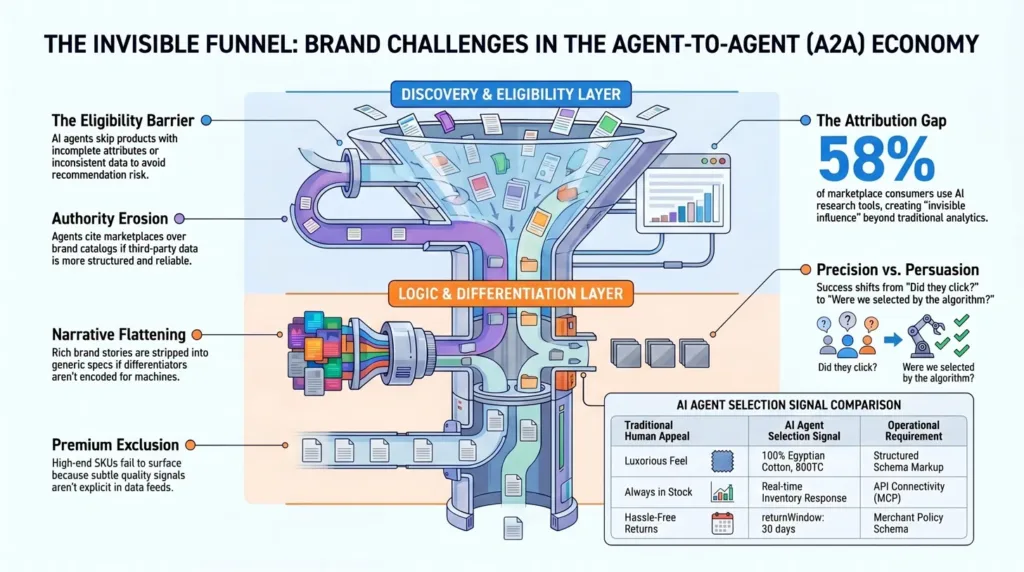
A human shopper responds to narrative, design, and merchandising. An agent building a shortlist reads structured product data — identifiers, attributes, policy fields, ratings, certifications — and treats unstructured marketing copy as low-signal. The work that wins a person’s attention is largely invisible to the system that decides whether a person sees the brand at all.
When an attribute it expects is missing or ambiguous, an agent skips the product rather than guess. The agent is being risk-averse: it can’t recommend a product it can’t vouch for. The judgment isn’t “this brand is worse than that one,” it’s “I can’t tell what this brand is” — and from the outside, those two outcomes look identical. Stibo Systems calls this decision invisibility: the brand gets filtered out before a human is in the loop, so there’s no bounce-rate change to notice and no campaign to diagnose (Molino Sánchez, 2026).
The evidence on what agents actually weigh
The clearest read on agent behavior comes from controlled testing, not inference. For a 2026 Harvard Business Review study, Sabbah and Acar ran more than 16,000 simulated purchase decisions across four models, testing eight standard promotional mechanisms against a deliberately ordinary set of products. One signal moved selection upward consistently across every model and category: structured ratings. Strike-through pricing and countdown timers showed no stable pattern at all. Bundling was worse than no pattern — in at least one case it actually reduced selection. The reasoning models came out the most skeptical of the bunch, in several cases appearing to penalize overt persuasion as a quality signal in its own right (Sabbah & Acar, 2026).
The study is consumer-scoped, so the specific numbers won’t generalize to every category. The shape of the finding probably does. A promotional layer many merchandising teams treat as free can suppress selection on the surface an agent reads, and several of the tactics built to persuade a person work against the brand when an agent is the one reading. The fix for being skipped is structural.
Why the loss doesn’t show up in the dashboard
Decision invisibility persists because it’s invisible by construction. Discovery and comparison happen within the agent; the customer, when they arrive, does so via a direct or organic path, and whatever determined the choice leaves no trace in the merchant’s analytics (Hanna, 2026). Query fan-out and zero-click shortlisting mean the brand sees neither the queries it lost nor the comparisons it was excluded from.
That creates a specific problem for how the issue gets prioritized. Every other category of marketing problem announces itself through a metric that moves, and any triage process that allocates attention to dashboards will pass over decision invisibility — because the dashboards don’t move. The financial logic compounds it: a loss that can’t be attributed doesn’t enter the ROI calculation, and a cost that can’t be priced is reliably under-prioritized against costs that can. The absence of a signal is the expected presentation of the problem, not evidence that it’s small.
A concrete version of the failure
Picture a premium mattress brand. Its flagship justifies the price through materials, construction quality, and a 20-year warranty — and the brand communicates all of it well, in copy and imagery written for a human reader. None of it lives in a structured field that an agent can read.
So when an agent compares mattresses in the category, it works from what it can actually see: dimensions, firmness rating, and price. The premium product shows up described by the same defaults as a $400 competitor, and gets ranked on price against products it was never meant to compete with. The positioning is intact. The data erases it.
The more common and more expensive version of this mistake follows the same shape: investing in a strategic capability. At the same time, a prerequisite goes unaddressed — a quarter spent standing up an agent initiative while the return policy still lives in unstructured HTML.
What this changes
The inputs that set the urgency — agent adoption, and the data quality of competitors and marketplaces — sit outside any one brand’s control and are moving in a single direction. The variable a brand does control is its own legibility to the systems now making the selection, and it’s the one most often deferred, because nothing in the current measurement stack reports its decline. Whether an agent can resolve a brand, compare it on equal terms, and find structured grounds to trust it is now a question worth answering deliberately, rather than letting it be answered by omission. A diagnostic discipline like the Brand Visibility for Agentic Commerce Framework (BVAC) exists to make that question answerable; the prior step, and the point of this piece, is recognizing that this is the question that now determines whether the brand is in the set at all.
References
Adobe Analytics. (2026). AI-driven traffic surges across industries, retail sees biggest gains [2025 holiday shopping recap]. Adobe.
Capgemini Research Institute. (2025). What matters to today’s consumer (4th ed.). Capgemini.
Hanna, C. (2026). Attribution gap in agentic search: How to close it. Semrush.
MetaRouter. (2026). Agentic commerce trends and statistics for 2026. MetaRouter. (Conversion figure attributed to McKinsey.)
Molino Sánchez, M. (2026). 7 signs your brand is losing ground in agentic commerce. Stibo Systems.
Sabbah, J., & Acar, O. A. (2026, May 12). Research: Traditional marketing doesn’t work on AI shopping agents. Harvard Business Review.