If your CFO asked for 20% of the MarTech budget on Monday morning, would your team agree on which tool goes first?
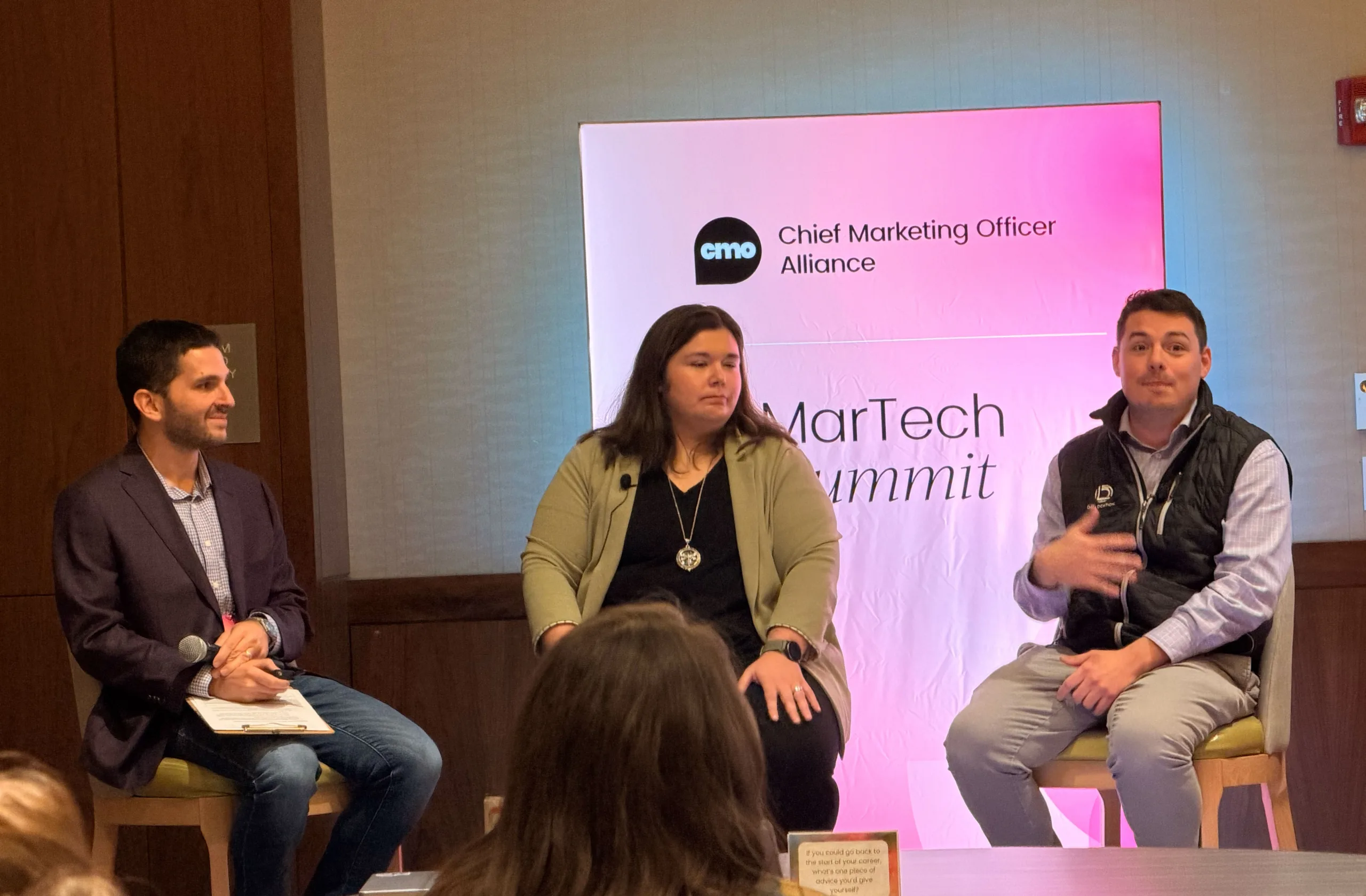
Most speakers at the CMO Alliance MarTech Summit Boston, held October 27 at The Westin Boston Seaport, addressed some version of that question. Jonathan Kriner, Director of Ad Marketing at Roku, chaired the day and closed it with a peer exercise built on exactly that scenario: a $730,000 stack, eight tools, and a $146,000 savings target. Teams struggle with that exercise for reasons that have little to do with software. No one has agreed on the criteria, and no one owns the decision.
The speakers arrived at the same conclusion from different directions. Platforms get the budget line and the vendor attention. People and process decide whether any of it survives the next budget cycle.
Keep people as the layer that decides whether the tools stay.
Abby Koble, VP of Global Marketing Operations at Cornerstone OnDemand, opened the main stage with the argument that people remain the critical layer in the MarTech stack. Her premise: every marketing organization now has access to AI capability. Licenses are signed, and pilots are running. What most teams lack is an operating model for turning that capability into work people do differently — clear ownership, team fluency, and a reason for adoption to outlive the person who championed it.
I’ve watched this play out more than once. A pilot shows results, the sponsor changes roles, and six months later the tool is still paid for, and nobody can name who uses it. They file the failure under technology, and the next vendor demo begins.
Koble’s framing puts the fix where it belongs. Ownership and process cost less to define than a platform migration, and they are the parts that make the platform spend recoverable.
Standardize the work before you hand it to an agent.
Tom Capone, Director of Marketing Technology, Strategy and Operations at the National Football League, made the case for templatization as the prerequisite for agentic tools. His session drew on managing a multi-environment operation on Adobe Experience Platform and Adobe Journey Optimizer, and the argument ran in one direction: standardization at the team and process level creates the foundation for AI adoption, with efficiency gains as a byproduct.
This matches what I see in enterprise deployments. Speed without consistency accelerates existing disorder, and an agent operating on an unstandardized process reproduces it faster than a person could. Coherence at velocity requires coherence first. A shared template and an agreed planning cadence do more to prepare a team for agentic tooling than another model subscription.
Separate confidence from accuracy in your measurement
Adam Pickel, Field Technology Officer at Concentrix, delivered the sharpest point of the day on measurement. Marketing measurement has always had gaps. The difference now is how teams relate to them.
“There have always been gaps in measurement, but we always knew they were incomplete. But now we have more confidence sometimes because there is more information provided,” Pickel said.
A team with 12 dashboards feels more certain than a team with 2, and the attribution model underneath may be no better. The fireside chat with Sean Stewart of On Location, Loralee Bronte of Next Day Access, and Kriner took up the same problem from the operational side: proxy metrics, fragmented channel data, and attribution models that have drifted away from actual purchasing behavior, reported to executives who then make investment decisions on other numbers entirely. Allyson Barr, CMO at ActiveState, addressed the related tension of making one stack serve both brand and performance work, which depends on the same measurement discipline.
This matters for the triage question. A team deciding which tools to cut leans on attribution it trusts more than it should, and the tool that looks underused may hold the only reliable audience data in the building. Pickel’s point works as an instruction: audit the confidence before you audit the spend.
Run the triage before finance runs it for you.
Kriner’s closing exercise supplies the method. Take the scenario as given: $730,000 across eight tools, $146,000 to find. Two platforms overlap on email and journey orchestration. One personalization tool shows low login counts. A data enrichment subscription has no obvious campaign attached to it.
The easy cut is the personalization tool. Low usage, mid-tier cost, and nobody on the team will defend it in the meeting. Then someone checks what feeds it and finds that it holds the only maintained segment definitions for the lapsed-customer audience, and that the “overlapping” journey platform reads those segments every week. Cutting it saves $60,000 and breaks the reactivation program that produces more measurable revenue than anything else in the stack.
Triage works when the team runs it against ownership, workflow, and data dependency rather than the invoice. A few moves hold up across most stacks:
- Assign an owner to every line item before scoring it. Tools without an owner go unused, regardless of what the contract says.
- Map the data each tool holds that nothing else does. Lose the license, lose the data, and the cost reappears two quarters later under a different name.
- Cut overlap based on who runs which workflow. Two tools that look redundant on a comparison grid often serve different teams with different processes, and merging them is a change management project with a software line attached.
Treat adoption as the deliverable.
Max Fund, Director of Marketing AI Operations at Palo Alto Networks, closed the content portion with a framework for large-scale operational transformation, drawn from a global pilot program that scaled generative AI across hundreds of marketers and reduced agency spend. His emphasis fell on executive buy-in, institutional inertia, and tying AI workflows to business-critical KPIs. Agency spend reductions, incidentally, remain the AI result CFOs recall most reliably.
Pickel had made the complementary point earlier: bolt-on AI deepens existing silos, and infrastructure built for customer behaviors that have since changed cannot be fixed by adding a layer on top. His prescription was reconstruction of data foundations and org design.
Put the two together, and the asset in the stack becomes clearer. When a tool changes, a team keeps the customer file, the segment definitions, the measurement scaffolding, and the record of what has already worked. Those survive triage, and they are what AI tools need to do anything useful.
The format helped. With roughly 100 attendees, Kriner’s triage ran in peer groups at tables, arguing over the same eight tools, a conversation that doesn’t happen on a 10,000-person exhibit floor.
So, back to that Monday morning meeting. Before the 2027 budget cycle asks the 20% question for you, run the triage yourself: name an owner for every tool and map the data each one holds alone. Check how much of your attribution confidence you have earned. Then cut.