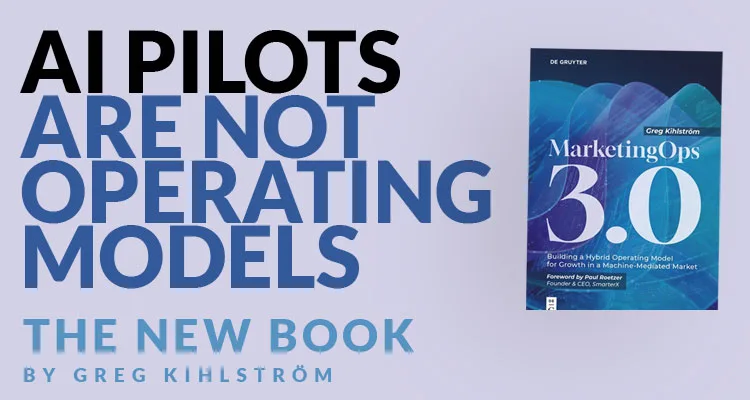
MarketingOps 3.0: Building the Hybrid Operating Model for Growth in a Machine-Mediated Market introduces a framework for coordinating marketing, sales, service, and product as a single Commercial System run by humans and AI agents
Arlington, VA | October 5, 2026 — Author, advisor, and marketing technology expert Greg Kihlström has announced his forthcoming book, MarketingOps 3.0: Building the Hybrid Operating Model for Growth in a Machine-Mediated Market, a practical guide for leaders building the operating model required when autonomous agents participate in commercial work on both sides of the transaction. The book addresses a market in which consumers and buyers increasingly use personal AI assistants to compare options, evaluate claims, and narrow the field before a human takes a serious look, making machines the first audience for a growing share of commercial interactions.
At the center of the book is Commercial Operations Orchestration (CO2), a framework that establishes a shared operating layer across marketing, sales, service, and product. CO2 replaces departmental handoffs with shared context, shared truth, and clear decision rights, giving organizations a way to coordinate action at machine speed without losing governance or customer trust. The book positions MarketingOps as the discipline that designs, governs, and measures that system.
Combining strategic arguments with implementation details, the book examines why earlier MarketingOps models reached their limits, defines the hybrid workforce and the human-agent squad, introduces the Human Premium and the Bot Manager role, and explains how customer experience changes in what the book calls the Business-to-Agent-to-Consumer (B2A2C) economy. It covers the move from omnichannel to omni-agent interaction, from campaigns to next best action, and from transactional measurement to lifetime value. It also formalizes Return on Agent (ROA) as the economic measure leaders should apply to hybrid work, and closes with a discussion on governance, ethics, talent, and a roadmap for execution, including the structure and operating cadence of a CO2 Council.
“Most organizations will not fail this transition because they lack ideas,” says Greg Kihlström. “They will fail because they mistake activity for progress, tools for strategy, and pilots for operating models. This book gives leaders a way to tell the difference, and a model they can actually run.”
A key differentiator is the book’s treatment of AI as a structural change to how work is designed, governed, and measured. It addresses machine readability, agent governance, and orchestration as leadership issues with direct commercial consequences, covering what happens when pricing logic is inconsistent, product information is fragmented, or policies live in disconnected documents when a customer’s agent evaluates a brand. The book includes a one-page operating model, along with toolkits and templates intended for use as decision devices in live transformation work.
Paul Roetzer, a leading voice on artificial intelligence for business leaders and practitioners, provides the Foreword. Roetzer founded SmarterX and Marketing AI Institute, has delivered more than 300 conference keynotes and private engagements for brands, agencies, technology companies, investors, non-profits, and educational institutions, and works with executives on what AI means for their organizations and how to adopt it strategically. Through his research, podcast, book, speaking, and businesses, he translates AI developments into practical strategies for piloting and scaling AI.
Kihlström brings extensive real-world experience to the subject. He is a best-selling author, speaker, consultant, and advisor who has worked with brands including Adidas, Coca-Cola, FedEx, HP, Marriott, Nationwide Insurance, Victoria’s Secret, and Toyota. He has written more than 25 books on marketing and marketing technology and hosts several business and marketing podcasts, including The Agile Brand with Greg Kihlström®.
MarketingOps 3.0: Building the Hybrid Operating Model for Growth in a Machine-Mediated Market is written for CMOs and senior marketing executives, MarketingOps, RevOps, and Commercial Ops leaders, and the transformation teams responsible for turning AI investment into an operating capability. Readers can use it sequentially or by role, with the strategic case, the CO2 model, the ROA framework, and the governance chapters serving executives making investment and structure decisions.
Details
Publication Date: October 5, 2026; ISBN: 9783112218839; Edition: Paperback & Digital
More information is available here: https://www.degruyterbrill.com/document/doi/10.1515/9783112218839/html
About Greg Kihlström
Greg Kihlström is a MarTech futurist, best-selling author, speaker, entrepreneur, and advisor on marketing technology, marketing operations, and digital transformation. He advises and consults for leading organizations and frequently writes, speaks, and hosts podcasts on the future of marketing, customer experience, and business agility. He teaches as a member of the School of Marketing Faculty at the Association of National Advertisers (ANA).
About De Gruyter Brill
De Gruyter Brill is an independent, family-owned academic publisher and a global leader in the humanities and beyond. Committed to excellence, we work with scholars across disciplines to make their contributions available to the global research community and the public. We publish reference works, books, journals, and research tools in subject areas ranging from the humanities, arts, architecture, and social sciences to science, technology,y and medicine.