This article is based on a Q&A with dig CMO Chen Guter and Greg Kihlström for The Agile Brand Guide’s Expert Mode series.
Most brand teams still monitor social media by reading it. Someone writes a keyword brief, and a listening tool pulls back the captions, hashtags and comments that match. When a launch goes sideways, we assume the complaint will show up in the words first.
Skims’ $148 Accessories Advent Calendar suggests otherwise. The 12-door box went on sale with the brand’s holiday shop on October 29, and within two weeks buyers filming themselves opening it had pushed Skims into offering every customer a full refund or store credit. Chen Guter, CMO at dig, which analyzes social video for brands, argues the story broke on camera and mostly stayed there. dig sells exactly that kind of analysis, so her argument comes with a commercial interest attached. She was also direct about when it isn’t worth paying for.
The Complaint Was in the Hands, Not the Caption
Guter came to this from the buyer’s side. She says she spent ten years at P&G on brands including Pantene and Pampers, writing the keyword briefs that fed social listening tools. That approach worked, she said in a recent exchange, because for about 20 years people wrote down what they thought.
The Skims calendar is the clearest case I’ve seen. The video that started it showed a creator holding up a hair tie, with almost no words, and it reached around 72 million views. TikTok alone carried 81% of all views on the calendar. The word that took over was “SKAMS,” with a K. I would never have put that on a monitoring brief.
TikTok carried four in five calendar views

Source: dig. US and UK creators on TikTok, Instagram, X, YouTube, Facebook and Reddit, last 30 days. Data as of 12 Nov 2026. Figures are dig’s own.
Text still does the job, she said, “when the conversation is written,” and she named reviews, customer service, Reddit, a lot of B2B and financial news. In the Skims case, X and Reddit together drew under 4% of the calendar’s views by dig’s count. So the question for a marketing leader isn’t really whether to buy video analysis. It’s where your own customers react. A B2B software company whose buyers argue on Reddit can probably keep reading. An apparel brand whose customers hold the product up to a phone can’t, and its brand sentiment score may be built on the slice of the conversation that matters least. Before the next listening contract renews, ask the vendor what share of your category’s conversation is video. Then ask whether their tool watches it or only reads the caption.
Captions Said “Festive.” The Videos Said Something Else.
Between October 29 and November 5, dig found 39 posts about the calendar, with almost no views. On November 6, a creator opened all 12 doors in one video, and viewers could see the whole $148 at once: a few pins, some hair ties, a keychain. By the end of that day dig counted 192 posts and around 213 million views. Ninety-one percent of them were negative.
From 39 posts in eight days to 192 in one

Source: dig. US and UK creators on TikTok, Instagram, X, YouTube, Facebook and Reddit, last 30 days. Data as of 12 Nov 2026. Figures are dig’s own.
Guter on what a caption-only team would have seen that day:
A team reading only captions would have seen a busy, festive day, with captions like “12 days of skims unboxing part 2” and a few emojis. More than half of the negative videos had no complaint or price word in the caption, and 12% didn’t mention “advent” or “calendar” at all. That team would have seen volume going up, and nothing that told them why.
Most negative videos never typed the complaint

Source: dig. US and UK creators on TikTok, Instagram, X, YouTube, Facebook and Reddit, last 30 days. Data as of 12 Nov 2026. Figures are dig’s own.
We asked how dig got there. It looked at US and UK creators on six platforms over 30 days. Its multimodal AI model decides from the video itself whether a post is about the calendar, then reads tone from what’s on screen and what’s said, sarcasm included. Guter also corrected her own team’s pitch. The 98% negative figure dig had circulated came from an earlier, smaller read of US TikTok and YouTube. With the full data, it’s 91% on November 6 and 79% for everything up to that day. “I’d rather you use the lower number,” she said. Vendors rarely volunteer that. Any sentiment figure drawn from video is a model’s judgment, and it moves with the sample. A CMO evaluating these tools should ask what counted as a post and how tone is scored, and whether each number links back to the posts behind it. Guter says dig’s do.
A Tool Can’t Fix a $148 Box of Hair Ties
The obvious objection is that Skims listed the calendar’s contents on its product page, and no amount of monitoring changes a product decision. Guter agrees. She gives Skims credit for using the roughly 24 hours it had, and argues the video matters most after a brand responds, because the story keeps moving.
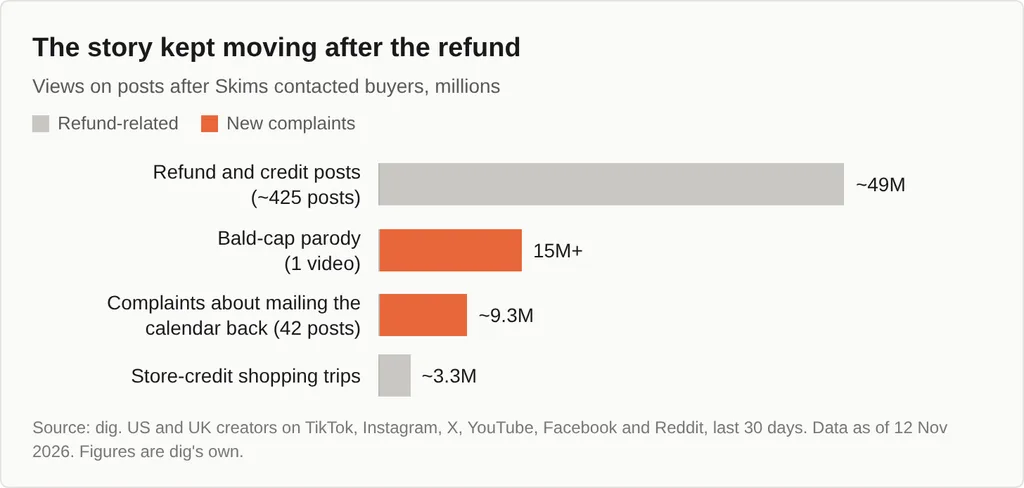
First, the requirement to mail the calendar back became a complaint of its own, with 42 posts and around 9.3 million views. Then the comments started calling the store credit a way to make people spend more. A few days later, a creator put on a bald cap, opened the calendar, and held up one hair accessory after another she couldn’t use. That video passed 15 million views and brought everyone back to the product. Each of those turns was visible in the videos and comments before it peaked.
The story kept moving after the refund
Source: dig. US and UK creators on TikTok, Instagram, X, YouTube, Facebook and Reddit, last 30 days. Data as of 12 Nov 2026. Figures are dig’s own.
The mail-back complaint had a basis. Per Fortune, the email buyers received said a cash refund meant sending the calendar back, while customers who took store credit could keep it. Guter was just as specific about when to skip the spend: when a category’s conversation is mostly written, when social volume is small, “or when nobody in the company can act on what the data shows. In those cases, save the money.” The last condition is the one to test yourself against. If nobody can change the customer email over a weekend, a faster read on sentiment doesn’t buy much.
The Refund Worked. The Sentiment Didn’t Follow.
Guter thinks the refund was the right call, and that the way Skims delivered it mattered as much as the offer.
Skims emailed every buyer directly with a choice: a full refund or store credit. The fix went straight to the people who paid, and then it spread the way the complaint had. Buyers filmed their inboxes and their store-credit shopping trips, and refund posts reached around 49 million views. Around 8 November, positive posts went up for the first time.
The refund didn’t turn sentiment around

Source: dig. US and UK creators on TikTok, Instagram, X, YouTube, Facebook and Reddit, last 30 days. Data as of 12 Nov 2026. Figures are dig’s own.
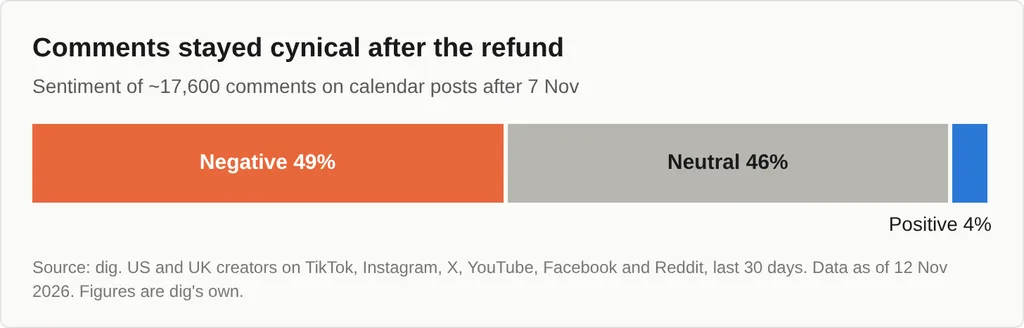
The mood didn’t hold, though. By dig’s count, calendar posts from November 7 onward were still 68% negative, and 67% on November 11. Of roughly 17,600 comments after November 7, 49% were negative and just 4% positive.
Comments stayed cynical after the refund
Source: dig. US and UK creators on TikTok, Instagram, X, YouTube, Facebook and Reddit, last 30 days. Data as of 12 Nov 2026. Figures are dig’s own.
The number Guter would actually watch is a small one. “SKAMS” has turned up in the comments of 236 posts that have nothing to do with the calendar. “If it keeps spreading, the joke has started to stick to the brand,” she said. She still expects Skims to recover quickly, partly because the complaints were about value rather than the core product. “Nobody criticised the shapewear.”
Her comparison is Chanel’s $825 advent calendar in 2021. After TikTok creator Elise Harmon’s unboxings took off, Chanel’s answer came days later, when fashion president Bruno Pavlovsky told WWD the house would be “much more cautious” in future. Skims, by Guter’s account, reached its buyers within about a day. Chanel answered through the trade press. Skims answered in buyers’ inboxes, and the buyers posted the answer themselves.
Which brings us back to the keyword brief. For a CMO with holiday launches coming and no budget for a new tool, Guter’s advice doesn’t start with software. Name one owner per launch, from social, comms or CX, for the first 72 hours. That person watches the first unboxing videos “with the sound on,” reads the comments and searches the platform for the product name, with a 15-minute daily check-in with comms and CX. Agree before launch what counts as trouble. For Skims, three things landed together: volume jumped from 39 posts in eight days to 192 in one, the comments turned to money, and a nickname appeared. For a premium brand heading into gifting season, she says, that combination is a P&L problem and should go straight to the CMO.
Then settle what she calls “the Saturday question” now: what you’ll offer, up to what cost, and the one person who can approve it on a weekend without a meeting. Write the customer email while things are calm. Skims had about 24 hours, Guter notes, and a lot of brands would spend that time waiting for sign-off. And keep the same owner ready for a good weekend. “Your customers are making your ads now,” she said. If an early video loves the product, put spend behind it while people are still watching.