
Definition
As we move into the agentic commerce era, where AI agents execute purchases on behalf of humans, the underlying infrastructure must shift from human-readable websites to machine-readable standards. For AI agents to effectively discover products, coordinate tasks, and settle payments autonomously, they rely on standardized frameworks. This wiki gives an overview of the major protocols—UCP, ACP, A2A, and AP2—and explains how they fit together to power the future of retail.
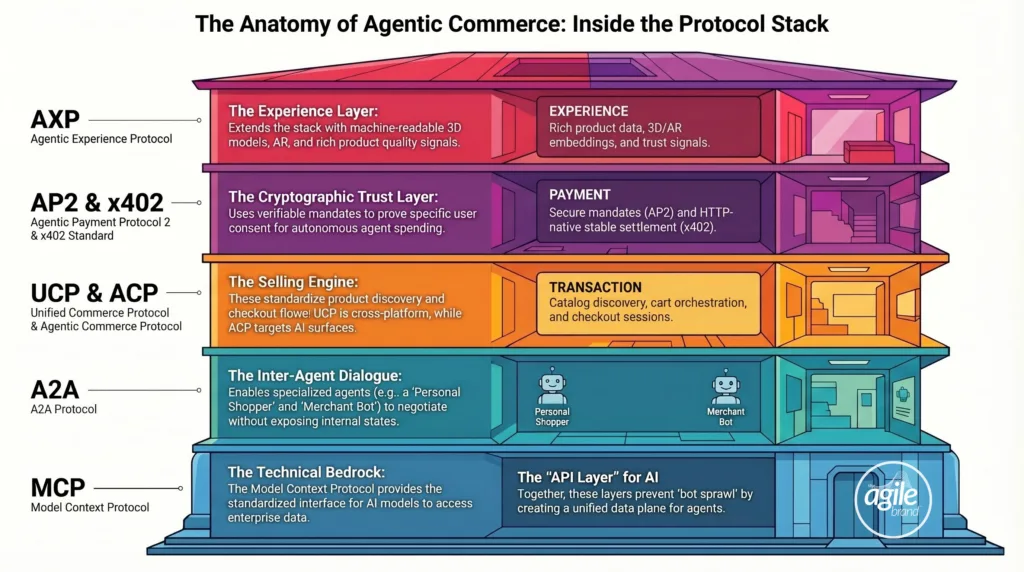
1. Discovery and Checkout (UCP & ACP) The fundamental layer of agentic commerce involves how an AI assistant finds your products and seamlessly places them into a cart. The Universal Commerce Protocol (UCP) acts as the canonical transaction and discovery envelope for this process. It allows AI agents to directly query merchant catalogs, check inventory, and manage checkout sessions in a standardized format, eliminating the need for custom builds across different retailers.
Operating alongside UCP is the Agentic Commerce Protocol (ACP), an open standard maintained by industry heavyweights like OpenAI and Stripe. ACP standardizes the checkout orchestration flow, bridging the gap between AI assistants and merchant systems by coordinating buyer intent, agent execution, and payment delegation. For marketing and CX leaders, supporting these protocols ensures that when an AI shopping agent looks for the best product for a user, your catalog is fully discoverable and transactable.
2. Trust and Settlement (AP2 & x402) Payment execution by autonomous agents requires rigorous trust layers; otherwise, merchants and consumers face massive liability, dispute, and fraud risks. The Agent Payments Protocol (AP2), proposed by Google in collaboration with PayPal and others, handles agent-led payments using cryptographically verifiable mandates. AP2 ensures that transactions are secure, accountable, and explicitly tied to a user’s signed intent—from cart creation to final payment execution. This protocol drastically reduces disputes by mapping order confirmations, receipts, and policies directly to an undeniable consent artifact preserved in an audit trail.
Additionally, emerging protocols are defining new commercial models for machine-to-machine transactions. Frameworks featuring x402-style pricing models support fluid, dynamic transactions—such as “up-to” pricing or multi-round negotiated schemes—tailored specifically for AI agents transacting with one another in real time.
3. Multi-Agent Coordination (A2A) Complex purchases and enterprise workflows rarely rely on a single AI model; they require multiple specialized agents working in tandem. The Agent2Agent (A2A) protocol—an open standard hosted by the Linux Foundation and actively supported by Google—enables seamless communication, task delegation, and negotiation between different AI agents, regardless of their underlying framework or vendor.
A2A allows agents to collaborate in unstructured modalities and securely exchange data using enterprise-grade authentication. This means a consumer’s general personal assistant agent can easily communicate with a retailer’s specialized “Business Agent” to coordinate a complex transaction, check custom inventory, and negotiate terms without any human intervention.
What Leaders Should Do Technology, marketing, and CX leaders must prioritize a layered implementation strategy to prevent ecosystem lock-in and ensure deep compatibility with AI shoppers.
- Start by implementing UCP discovery endpoints (such as hosting a /.well-known/ucp manifest file) to advertise your store’s capabilities and make your catalog parseable to AI agents.
- Enable ACP integration to orchestrate frictionless checkout flows directly within AI assistants like ChatGPT.
- Integrate AP2 mandates to secure verifiable, auditable agent payments, protecting your margins with robust cryptographic consent and reducing the risk of agent-driven fraud.
Summary
The winners of the agentic commerce era will not necessarily be the brands with the most visually stunning traditional websites. The true winners will be those whose tech stacks fluently speak the language of the new protocol economy. Choosing to adopt and implement the right interoperable standards today is the key to remaining visible, trusted, and transactable to the autonomous shoppers of tomorrow.
Related Terms
- AI shopping agent
- Agentic checkout
- In-context selling
- Product information management (PIM)
- Structured product data
- Offer eligibility rules
- Loyalty program orchestration
- Agentic Commerce Protocols Overview
- Model Context Protocol (MCP)
- Agentic Commerce Protocol (ACP)
- Agent Payment Protocol (AP2)
- Unified Commerce Protocol (UCP)
- Unified Incentives Protocol (UIP)
- Agent2Agent Protocol (A2A)
- Agent Skill
- Agent Card